Yang Transform Approach to Renewal Equations and Integral Equations
DOI:
https://doi.org/10.56714/bjrs.51.2.10Keywords:
Convolution Theorem, integro-differential equations, integral transforms, integral equationsAbstract
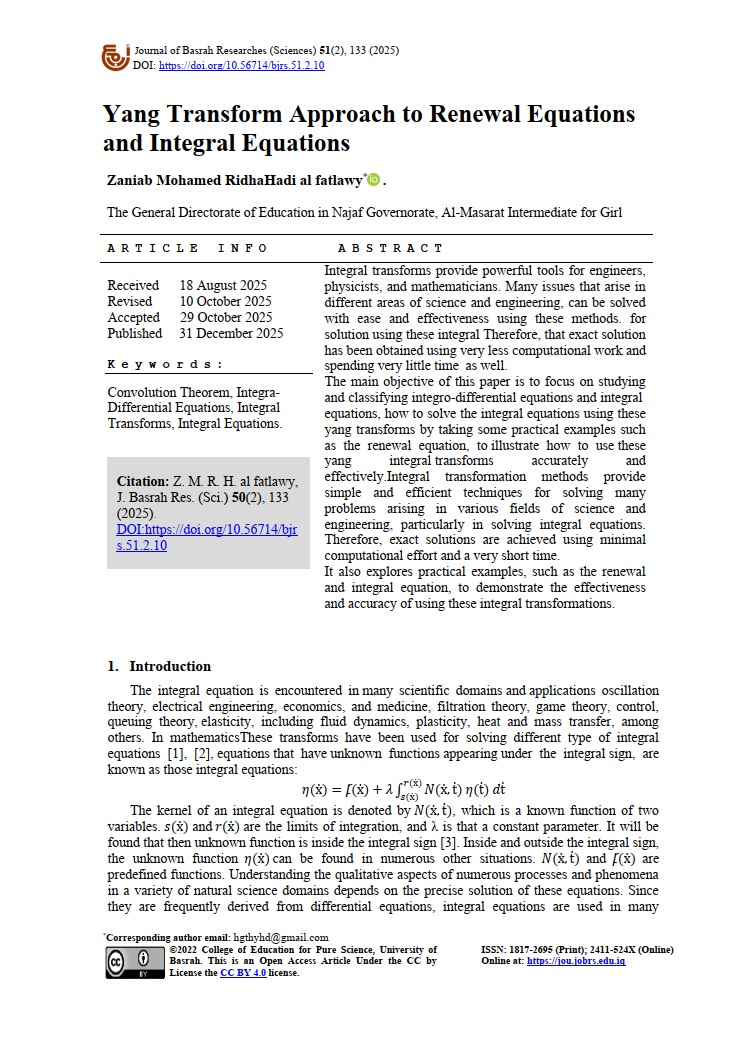
Integral transforms provide powerful tools for engineers, physicists, and mathematicians. Many issues that arise in different areas of science and engineering, can be solved with ease and effectiveness using these methods. for solution using these integral Therefore, that exact solution has been obtained using very less computational work and spending very little time as well.
The main objective of this paper is to focus on studying and classifying integro-differential equations and integral equations, how to solve the integral equations using these yang transforms by taking some practical examples such as the renewal equation, to illustrate how to use these yang integral transforms accurately and effectively.Integral transformation methods provide simple and efficient techniques for solving many problems arising in various fields of science and engineering, particularly in solving integral equations. Therefore, exact solutions are achieved using minimal computational effort and a very short time.
It also explores practical examples, such as the renewal and integral equation, to demonstrate the effectiveness and accuracy of using these integral transformations
Downloads
References
[1] H. Jafari, “A new general integral transform for solving integral equations,” J. Adv. Res., vol. 32, pp. 133–138, 2021, doi: 10.1016/j.jare.2020.08.016. DOI: https://doi.org/10.1016/j.jare.2020.08.016
[2] G. Eshtewi, “Solving linear ordinary differential equations with variable coefficients using a new integral transformation,” JOPAS, vol. 24, no. 3, 2024, doi: 10.51984/jopas.v24i3.3807. DOI: https://doi.org/10.51984/jopas.v24i3.3807
[3] Y. Luchko, “Some schemata for applications of the integral transforms of mathematical physics,” Mathematics, vol. 7, no. 3, p. 254, 2019, doi: 10.3390/math7030254. DOI: https://doi.org/10.3390/math7030254
[4] N. Finizio and G. Ladas, An Introduction to Differential Equations with Difference Equations, Fourier Series, and Partial Differential Equations. Belmont, CA, USA: Wadsworth Publ. Co., 1982.
[5] M. K. U. Dattu, “New integral transform: Fundamental properties, investigations and applications,” IAETSD J. Adv. Res. Appl. Sci., vol. 5, no. 4, pp. 534–539, 2018.
[6] J. A. Jasim, E. A. Kuffi, and S. A. Mehdi, “A review on the integral transforms,” J. Univ. Anbar Pure Sci., vol. 17, no. 2, pp. 273–310, 2023, doi: 10.37652/juaps.2023.141302.1090. DOI: https://doi.org/10.37652/juaps.2023.141302.1090
[7] A.-M. Wazwaz, Linear and Nonlinear Integral Equations, 1st ed. Berlin, Germany: Springer, 2011, doi: 10.1007/978-3-642-21449-3. DOI: https://doi.org/10.1007/978-3-642-21449-3
[8] J. L. Schiff, The Laplace Transform, 1st ed. New York, NY, USA: Springer, 1999, doi: 10.1007/978-0-387-22757-3. DOI: https://doi.org/10.1007/978-0-387-22757-3
[9] X.-J. Yang, “A new integral transform method for solving steady heat-transfer problem,” Thermal Sci., vol. 20, no. Suppl. 3, pp. S639–S642, 2016, doi: 10.2298/TSCI16S3639Y. DOI: https://doi.org/10.2298/TSCI16S3639Y
[10] A. M. Cohen, Numerical Methods for Laplace Transform Inversion, 1st ed. New York, NY, USA: Springer, 2007, doi: 10.1007/978-0-387-68855-8. DOI: https://doi.org/10.1007/978-0-387-68855-8
[11] J. Liu, M. Nadeem, and L. F. Iambor, “Application of Yang homotopy perturbation transform approach for solving multidimensional diffusion problems with time-fractional derivatives,” Sci. Rep., vol. 13, no. 1, p. 21855, 2023, doi: 10.1038/s41598-023-49029-w. DOI: https://doi.org/10.1038/s41598-023-49029-w
[12] M. B. Finan, Laplace Transforms: Theory, Problems, and Solutions. Hoboken, NJ, USA, 2010.
[13] D. R. Grey, “Renewal theory,” in Handbook of Statistics, vol. 19, Amsterdam, Netherlands: Elsevier, 2001, pp. 413–441, doi: 10.1016/S0169-7161(01)19015-2. DOI: https://doi.org/10.1016/S0169-7161(01)19015-2
[14] G. V. Milovanović and D. Joksimović, “Some properties of Boubaker polynomials and applications,” in AIP Conf. Proc., vol. 1479, no. 1, pp. 1050–1053, Sep. 2012, doi: 10.1063/1.4756326. DOI: https://doi.org/10.1063/1.4756326
Downloads
Published
Issue
Section
License
Copyright (c) 2025 Basrah Researches Sciences

This work is licensed under a Creative Commons Attribution 4.0 International License.
This journal is licensed under the Creative Commons Attribution 4.0 International License (CC BY 4.0).
Under this license, users are permitted to read, download, copy, distribute, print, search, link to the full texts of articles, and create derivative works, including for commercial purposes, provided that appropriate credit is given to the original author(s) and the source.
The copyright of all published articles is transferred to the College of Education for Pure Sciences, University of Basrah. Proper attribution must include the article title, author name(s), journal name, DOI, and a link to the Creative Commons license.