
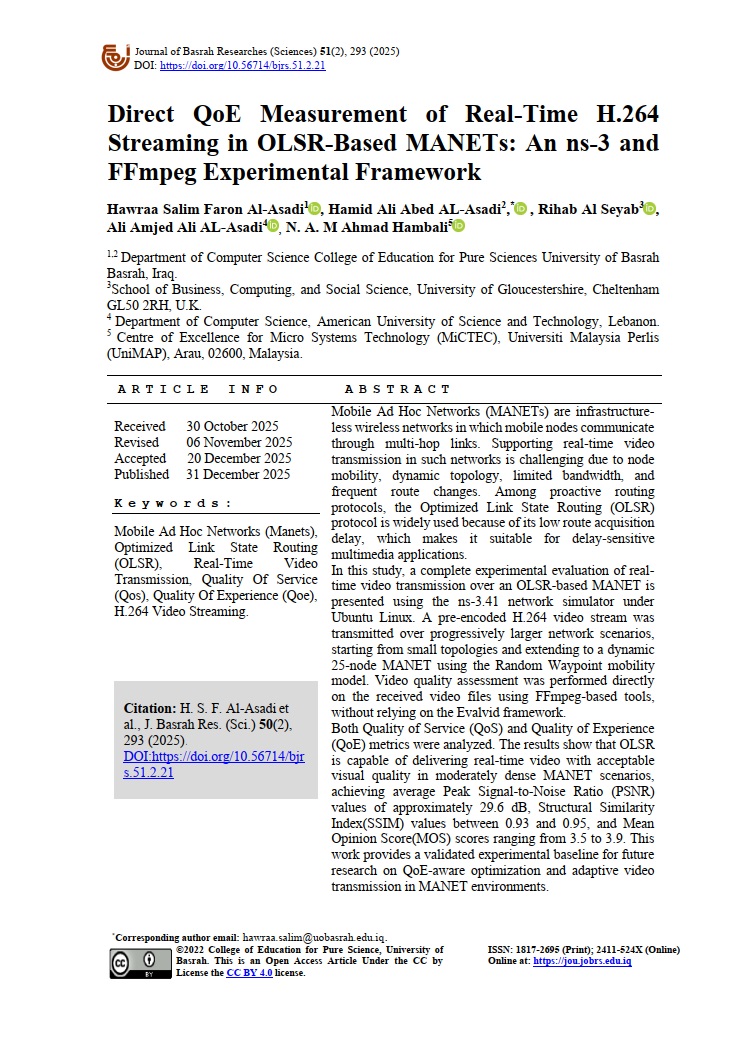
Direct QoE Measurement of Real-Time H.264 Streaming in OLSR-Based MANETs: An ns-3 and FFmpeg Experimental Framework
DOI:
https://doi.org/10.56714/bjrs.51.2.21Keywords:
Congestion Control, Active Queue Management, BLUE Algorithm, Deep Reinforcement Learning, DQN, Network SimulationAbstract
Mobile Ad Hoc Networks (MANETs) are infrastructure-less wireless networks in which mobile nodes communicate through multi-hop links. Supporting real-time video transmission in such networks is challenging due to node mobility, dynamic topology, limited bandwidth, and frequent route changes. Among proactive routing protocols, the Optimized Link State Routing (OLSR) protocol is widely used because of its low route acquisition delay, which makes it suitable for delay-sensitive multimedia applications.
In this study, a complete experimental evaluation of real-time video transmission over an OLSR-based MANET is presented using the ns-3.41 network simulator under Ubuntu Linux. A pre-encoded H.264 video stream was transmitted over progressively larger network scenarios, starting from small topologies and extending to a dynamic 25-node MANET using the Random Waypoint mobility model. Video quality assessment was performed directly on the received video files using FFmpeg-based tools, without relying on the Evalvid framework.
Both Quality of Service (QoS) and Quality of Experience (QoE) metrics were analyzed. The results show that OLSR is capable of delivering real-time video with acceptable visual quality in moderately dense MANET scenarios, achieving average Peak Signal-to-Noise Ratio) PSNR( values of approximately 29.6 dB, Structural Similarity Index)SSIM( values between 0.93 and 0.95, and Mean Opinion Score)MOS( scores ranging from 3.5 to 3.9. This work provides a validated experimental baseline for future research on QoE-aware optimization and adaptive video transmission in MANET environments
Downloads
References
[1] A. Abdellaoui et al., “Enhancing stability and efficiency in mobile ad hoc networks (MANETs): A multicriteria algorithm for optimal multipoint relay selection,” Information, vol. 15, no. 12, Art. no. 753, 2024. DOI: https://doi.org/10.3390/info15120753
[2] M. Conti and S. Giordano, “Mobile ad hoc networking: milestones, challenges and new research directions,” Computer Communications, vol. 180, pp. 347–366, 2021.
[3] I. Baird, I. Wadhaj, B. Ghaleb, and C. Thomson, “Impact analysis of security attacks on mobile ad hoc networks (MANETs),” Electronics, vol. 13, no. 16, Art. no. 3314, 2024. DOI: https://doi.org/10.3390/electronics13163314
[4] R. Agrawal et al., “Classification and comparison of ad hoc networks: A review,” Engineering, Technology and Applied Science Research, vol. 13, no. 2, pp. 10543–10552, 2023.
[5] P. Goyal, V. Rishiwal, and A. Negi, “A comprehensive survey on QoS for video transmission in heterogeneous mobile ad hoc networks,” Transactions on Emerging Telecommunications Technologies, 2023, doi: 10.1002/ett.4775. DOI: https://doi.org/10.1002/ett.4775
[6] A. M. Eltahlawy et al., “A survey on parameters affecting MANET performance,” Electronics, vol. 12, no. 9, Art. no. 1956, 2023, doi: 10.3390/electronics12091956. DOI: https://doi.org/10.3390/electronics12091956
[7] T. Clausen and P. Jacquet, “Optimized Link State Routing Protocol (OLSR),” IETF RFC 3626, Oct. 2003. DOI: https://doi.org/10.17487/rfc3626
[8] A. K. Singh and R. Sharma, “Analysis of routing and security issues in OLSR protocol for video streaming over MANET,” Journal of Discrete Mathematical Sciences and Cryptography, vol. 25, no. 3, pp. 887–903, 2022, doi: 10.1080/09720529.2022.2072439. DOI: https://doi.org/10.1080/09720529.2022.2072439
[9] V. Kalpana and S. Karthik, “Route availability with QoE and QoS metrics for data analysis of video stream over mobile ad hoc networks,” Wireless Personal Communications, vol. 114, pp. 2591–2612, 2020, doi: 10.1007/s11277-020-07491-z. DOI: https://doi.org/10.1007/s11277-020-07491-z
[10] S. Gowri and K. Kannan, “OCI-OLSR: An optimized control interval-based efficient routing mechanism for ad hoc networks,” Processes, vol. 11, no. 5, Art. no. 1419, 2023, doi: 10.3390/pr11051419. DOI: https://doi.org/10.3390/pr11051419
[11] D. Thakre and S. Awaya, “Performance study of AODV, OLSR, and DSDV routing protocols in mobile ad hoc networks,” International Journal of Microwave Engineering and Technology, vol. 10, no. 2, pp. 38–60, 2024.
[12] Md. Z. Hassan, Md. M. Hossain, and S. M. J. Alam, “The recent variants of OLSR routing protocol in MANET: A review,” International Journal of Advanced Networking and Applications, vol. 16, no. 1, pp. 6275–6280, 2024, doi: 10.35444/IJANA.2024.16106. DOI: https://doi.org/10.35444/IJANA.2024.16106
[13] K. Bouraqia, E. Sabir, M. Sadik, and L. Ladid, “Quality of experience for streaming services: Measurements, challenges and insights,” IEEE Access, vol. 8, pp. 13341–13361, 2020, doi: 10.1109/ACCESS.2020.2965099. DOI: https://doi.org/10.1109/ACCESS.2020.2965099
[14] H. Ziani, N. Enneya, and M. Kaicer, “A stochastic mobility metric to enhance QoS/QoE in mobile ad hoc networks,” International Journal of Innovative Technology and Exploring Engineering, vol. 9, no. 3, pp. 2392–2398, 2020, doi: 10.35940/ijitee.C9046.019320. DOI: https://doi.org/10.35940/ijitee.C9046.019320
[15] M. H. Jofri, I. A. Bahrudin, N. Z. Mohd Safar, J. M. Abdul, and H. Omar, “User quality of experience (QoE) satisfaction for video content selection framework in smartphone devices,” Baghdad Science Journal, vol. 18, no. 4 (Suppl.), pp. 1387–1396, 2021, doi: 10.21123/bsj.2021.18.4(Suppl.).1387. DOI: https://doi.org/10.21123/bsj.2021.18.4(Suppl.).1387
[16] N. A. Jabbar and A. D. Salman, “Implementing a proposal system for video streaming over MANET using NS-3, LXC and VLC,” in Advances in Intelligent Systems and Computing, vol. 1254. Singapore: Springer, 2021, pp. 255–266. DOI: https://doi.org/10.1007/978-981-15-7527-3_25
[17] E. P. Jara et al., “QSMVM: QoS-aware and social-aware multimetric routing protocol for video-streaming services over MANETs,” Sensors, vol. 21, no. 3, Art. no. 901, 2021, doi: 10.3390/s21030901. DOI: https://doi.org/10.3390/s21030901
[18] T. Padmapriya and S. V. Manikanthan, “Investigation of video streaming over MANET routing protocols,” International Journal of Interactive Mobile Technologies, vol. 16, no. 12, pp. 103–115, 2022, doi: 10.3991/ijim.v16i12.30805. DOI: https://doi.org/10.3991/ijim.v16i12.30805
[19] W. Zhou, X. Min, H. Li, and Q. Jiang, “A brief survey on adaptive video streaming quality assessment,” arXiv:2202.12987, 2022. DOI: https://doi.org/10.1016/j.jvcir.2022.103526
[20] B. Al-Hasani and B. M. S. Waheed, “Comparative study and performance investigation of MANET routing protocols,” International Journal of Nonlinear Analysis and Applications, 2022, doi: 10.22075/ijnaa.2022.27502.3627.
[21] H. A. Ahmed and H. A. A. Al-Asadi, “Performance evaluation of MANET routing protocols for transmitting video,” Journal of Basrah Researches (Sciences), vol. 49, no. 2, pp. 124–135, 2023, doi: 10.56714/bjrs.49.2.11. DOI: https://doi.org/10.56714/bjrs.49.2.11
[22] G. Liu and L. Kong, “Simulation of video streaming over wireless networks with NS-3,” arXiv:2302.14196, 2023.
[23] H. A. Ahmed and H. A. A. Al-Asadi, “An optimized link state routing protocol with a blockchain framework for efficient video-packet transmission and security over mobile ad hoc networks,” Journal of Sensor and Actuator Networks, vol. 13, no. 2, Art. no. 22, 2024. DOI: https://doi.org/10.3390/jsan13020022
[24] M. Jesús-Azabal, V. N. G. J. Soares, and J. Galán-Jiménez, “ML-enhanced live video streaming in offline mobile ad hoc networks: An applied approach,” Electronics, vol. 13, no. 8, Art. no. 1569, 2024. DOI: https://doi.org/10.3390/electronics13081569
[25] L. Zhao, Y. Cui, Y. Jia, Y. Zhang, and K. Nahrstedt, “Enhancing neural adaptive wireless video streaming via lower-layer information exposure and online tuning,” arXiv:2501.01044, 2025. DOI: https://doi.org/10.1109/TMM.2024.3521820
[26] R. U. Mustafa and S. Dassanayake, “Machine learning-based prediction of quality shifts on video streaming over 5G,” arXiv:2504.17938, 2025.
[27] M. H. H. Omar et al., “Using QoE metrics as a decision criterion in multimedia heterogeneous network optimization: Challenges and research perspectives,” Journal of Computer Networks and Communications, vol. 2024, Art. ID 7864757, 2024, doi: 10.1155/2024/7864757. DOI: https://doi.org/10.1155/2024/7864757
[28] Z. Wu, Y. Chen, H. Zhang, and K. Xu, “Orbis: Redesigning neural-enhanced video streaming for high-quality perception,” in Proc. ACM Int. Conf. Mobile Computing and Networking (MobiCom), New York, NY, USA, 2025. DOI: https://doi.org/10.1145/3715014.3722088
[29] D. You, J. Kim, and S. Lee, “Hierarchical QAM and inter-layer FEC for multi-view video plus depth format in two-way relay channels,” Applied Sciences, vol. 14, no. 19, Art. no. 8574, 2024. DOI: https://doi.org/10.3390/app14198741
[30] ITU-T Recommendation G.114, “One-way transmission time,” International Telecommunication Union, Geneva, Switzerland.
Downloads
Published
Issue
Section
License
Copyright (c) 2025 Basrah Researches Sciences

This work is licensed under a Creative Commons Attribution 4.0 International License.
This journal is licensed under the Creative Commons Attribution 4.0 International License (CC BY 4.0).
Under this license, users are permitted to read, download, copy, distribute, print, search, link to the full texts of articles, and create derivative works, including for commercial purposes, provided that appropriate credit is given to the original author(s) and the source.
The copyright of all published articles is transferred to the College of Education for Pure Sciences, University of Basrah. Proper attribution must include the article title, author name(s), journal name, DOI, and a link to the Creative Commons license.