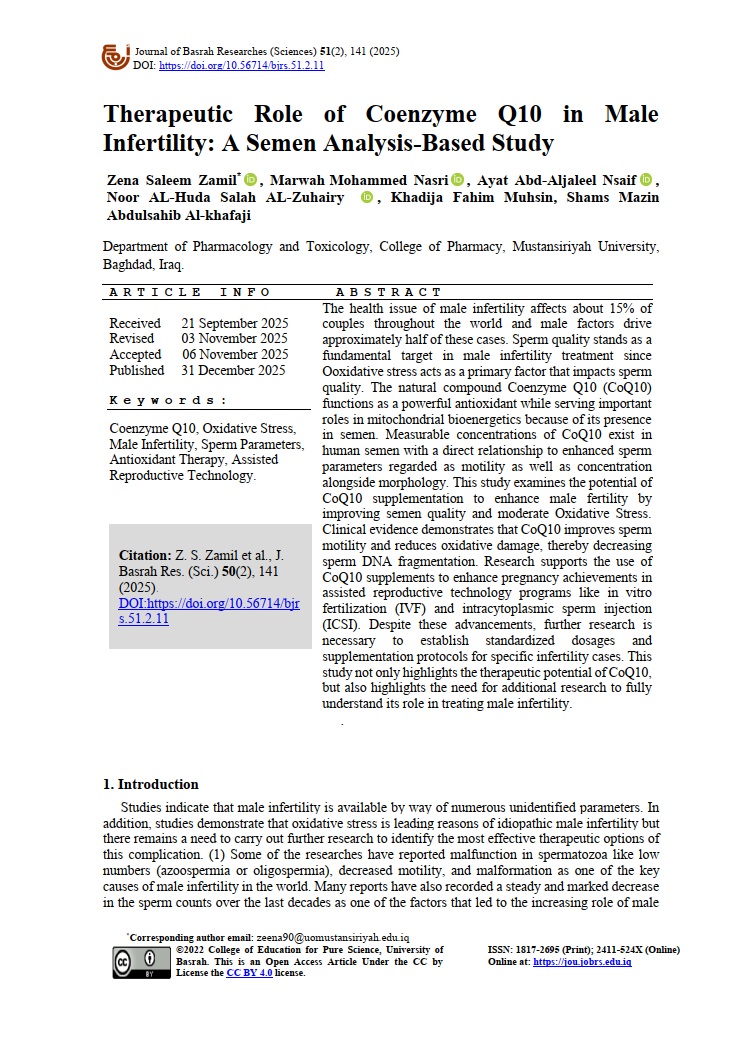
Therapeutic Role of Coenzyme Q10 in Male Infertility: A Semen Analysis-Based Study
DOI:
https://doi.org/10.56714/bjrs.51.2.11Keywords:
Coenzyme Q10, Oxidative Stress, Male Infertility, Sperm Parameters, Antioxidant Therapy, Assisted Reproductive TechnologyAbstract
The health issue of male infertility affects about 15% of couples throughout the world and male factors drive approximately half of these cases. Sperm quality stands as a fundamental target in male infertility treatment since Ooxidative stress acts as a primary factor that impacts sperm quality. The natural compound Coenzyme Q10 (CoQ10) functions as a powerful antioxidant while serving important roles in mitochondrial bioenergetics because of its presence in semen. Measurable concentrations of CoQ10 exist in human semen with a direct relationship to enhanced sperm parameters regarded as motility as well as concentration alongside morphology. This study examines the potential of CoQ10 supplementation to enhance male fertility by improving semen quality and moderate Oxidative Stress. Clinical evidence demonstrates that CoQ10 improves sperm motility and reduces oxidative damage, thereby decreasing sperm DNA fragmentation. Research supports the use of CoQ10 supplements to enhance pregnancy achievements in assisted reproductive technology programs like in vitro fertilization (IVF) and intracytoplasmic sperm injection (ICSI). Despite these advancements, further research is necessary to establish standardized dosages and supplementation protocols for specific infertility cases. This study not only highlights the therapeutic potential of CoQ10, but also highlights the need for additional research to fully understand its role in treating male infertility
Downloads
References
[1] A. Sharma, S. Minhas, W. S. Dhillo, and C. N. Jayasena, “Male infertility due to testicular disorders,” The Journal of Clinical Endocrinology & Metabolism, vol. 106, no. 2, pp. e442–e459, 2021, doi: 10.1210/clinem/dgaa781.
[2] E. Babakhanzadeh, M. Nazari, S. Ghasemifar, and A. Khodadadian, “Some of the factors involved in male infertility: a prospective review,” International Journal of General Medicine, pp. 29–41, 2020, doi: 10.2147/IJGM.S241099.
[3] S. C. Esteves, “Evolution of the World Health Organization semen analysis manual: where are we?” Nature Reviews Urology, vol. 19, no. 7, pp. 439–446, 2022, doi: 10.1038/s41585-022-00593-2.
[4] A. T. Alahmar, A. E. Calogero, R. Singh, and R. Cannarella, et al., “Coenzyme Q10, oxidative stress, and male infertility: A review,” Clinical and Experimental Reproductive Medicine, vol. 48, no. 2, p. 97, 2021, doi: 10.5653/cerm.2020.04175.
[5] T. M. Akhigbe, O. A. Ojo, A. O. Akhigbe, and A. O. Ajayi, et al., “Does coenzyme Q10 improve semen quality and circulating testosterone level? A systematic review and meta-analysis of randomized controlled trials,” Frontiers in Pharmacology, vol. 15, Art. no. 1497930, 2025, doi: 10.3389/fphar.2024.1497930.
[6] A. T. Alahmar, A. E. Calogero, P. Sengupta, and S. Dutta, “Coenzyme Q10 improves sperm parameters, oxidative stress markers and sperm DNA fragmentation in infertile patients with idiopathic oligoasthenozoospermia,” The World Journal of Men’s Health, vol. 39, no. 2, p. 346, 2020, doi: 10.5534/wjmh.190145.
[7] G. Salvio, R. Mancini, F. Condello, and G. Cosentino, et al., “Coenzyme Q10 and male infertility: A systematic review,” Antioxidants, vol. 10, no. 6, Art. no. 874, 2021, doi: 10.3390/antiox10060874.
[8] I. A. Silić, “Coenzyme Q10: A ubiquitous supplemental enzyme contributing to the health,” Science Insights, vol. 43, no. 5, pp. 1129–1140, 2023, doi: 10.15354/si.23.re825.
[9] A. Ouchi, S. Nagaoka, and K. Mukai, “Tunneling effect in regeneration reaction of vitamin E by ubiquinol,” The Journal of Physical Chemistry B, vol. 114, no. 19, pp. 6601–6607, 2010, doi: 10.1021/jp910856m.
[10] A. Brayfield, Ed., Martindale: The Complete Drug Reference, 39th ed. London, UK: Pharmaceutical Press, 2017.
[11] D. L. Nelson and M. M. Cox, Lehninger Principles of Biochemistry, 7th ed. New York, NY, USA: Macmillan Learning, 2017.
[12] A. Mannucci, A. Argento, G. Civitelli, and F. Catani, et al., “The impact of oxidative stress in male infertility,” Frontiers in Molecular Biosciences, vol. 8, Art. no. 799294, 2022, doi: 10.3389/fmolb.2021.799294.
[13] A. Barakat, R. Shegokar, M. Dittgen, and R. H. Müller, “Coenzyme Q10 oral bioavailability: Effect of formulation type,” Journal of Pharmaceutical Investigation, vol. 43, no. 6, pp. 431–451, 2013, doi: 10.1007/s40005-013-0101-4.
[14] V. E. Kagan, J. P. Fabisiak, and P. J. Quinn, “Coenzyme Q and vitamin E need each other as antioxidants,” Protoplasma, vol. 214, no. 1–2, pp. 11–18, 2000, doi: 10.1007/BF02524257.
[15] A. Majzoub and A. Agarwal, “Antioxidant therapy in idiopathic oligoasthenoteratozoospermia,” Indian Journal of Urology, vol. 33, pp. 207–214, 2017, doi: 10.4103/iju.IJU_15_17.
[16] Y. Jiang, Y. Han, P. Qiao, and F. Ren, “Exploring the protective effects of coenzyme Q10 on female fertility,” Frontiers in Cell and Developmental Biology, vol. 13, Art. no. 1633166, 2025, doi: 10.3389/fcell.2025.1633166.
[17] A. Agarwal, R. Henkel, R. Sharma, and A. Majzoub, et al., “Male oxidative stress infertility (MOSI): Proposed terminology and clinical practice guidelines for management of idiopathic male infertility,” World Journal of Men’s Health, vol. 37, pp. 296–312, 2019, doi: 10.5534/wjmh.190055.
[18] A. D. Bui, R. Sharma, R. Henkel, and A. Agarwal, “Reactive oxygen species impact on sperm DNA and its role in male infertility,” Andrologia, vol. 50, pp. 1–10, 2018, doi: 10.1111/and.13012.
[19] J. R. Drevet, “The antioxidant glutathione peroxidase family and spermatozoa: A complex story,” Molecular and Cellular Endocrinology, vol. 16, pp. 70–79, 2006, doi: 10.1016/j.mce.2005.12.027.
[20] P. Sengupta, G. M. Pinggera, A. E. Calogero, and A. Agarwal, “Oxidative stress affects sperm health and fertility—Time to apply facts learned at the bench to help the patient: Lessons for busy clinicians,” Reproductive Medicine and Biology, vol. 23, no. 1, Art. no. e12598, 2024, doi: 10.1002/rmb2.12598.
[21] M. Sunder and S. W. Leslie, “Semen analysis,” StatPearls [Internet]. Treasure Island, FL, USA: StatPearls Publishing, 2022.
[22] A. Agarwal, S. Roychoudhury, B. K. Bjugstad, and C. L. Cho, “Oxidation-reduction potential of semen: What is its role in the treatment of male infertility?” Therapeutic Advances in Urology, vol. 8, pp. 302–318, 2016, doi: 10.1177/1756287216652779.
[23] G. Dallner and R. Stocker, “Coenzyme Q,” in Encyclopedia of Dietary Supplements. New York, NY, USA: Marcel Dekker, 2005, pp. 121–131.
[24] A. Lewin and H. Lavon, “The effect of coenzyme Q10 on sperm motility and function,” Molecular Aspects of Medicine, vol. 18, suppl., pp. S213–S219, 1997, doi: 10.1016/S0098-2997(97)00036-8.
[25] H. A. E. H. Mansour, “Infertility diagnosis and management,” Beni-Suef University Journal of Basic and Applied Sciences, vol. 12, no. 1, p. 81, 2023, doi: 10.1186/s43088-023-00416-2.
[26] P. N. Schlegel, M. L. Sigman, D. J. Goldstein, and M. J. Diamond, et al., “Diagnosis and treatment of infertility in men: AUA/ASRM guideline part I,” The Journal of Urology, vol. 205, no. 1, pp. 36–43, 2021, doi: 10.1097/JU.0000000000001521.
[27] K. A. Preethi and D. Sekar, “Dietary microRNAs: Current status and perspective in food science,” Journal of Food Biochemistry, vol. 45, no. 7, Art. no. e13827, 2021, doi: 10.1111/jfbc.13827.
[28] R. Lafuente, M. Gonzalez-Comadran, I. Sola, and G. Lopez, et al., “Coenzyme Q10 and male infertility: A meta-analysis,” Journal of Assisted Reproduction and Genetics, vol. 30, pp. 1147–1156, 2013, doi: 10.1007/s10815-013-0047-5.
[29] A. Gvozdjakova, J. Kucharska, J. Dubravicky, and V. Mojto, et al., “Coenzyme Q10, α-tocopherol, and oxidative stress could be important metabolic biomarkers of male infertility,” Disease Markers, vol. 2015, Art. no. 827941, 2015, doi: 10.1155/2015/827941.
[30] A. T. Alahmar, “The impact of two doses of coenzyme Q10 on semen parameters and antioxidant status in men with idiopathic oligoasthenoteratozoospermia,” Clinical and Experimental Reproductive Medicine, vol. 46, no. 3, p. 112, 2019, doi: 10.5653/cerm.2019.00136.
[31] R. Festa, E. Giacchi, S. Raimondo, and L. Tiano, et al., “Coenzyme Q10 supplementation in infertile men with low-grade varicocele: an open, uncontrolled pilot study,” Andrologia, vol. 46, pp. 805–807, 2014, doi: 10.1111/and.12152.
[32] E. C. Garcia-Diaz, L. E. Gomez-Quiroz, E. Arenas-Rios, and A. Aragon-Martinez, et al., “Oxidative status in testis and epididymal sperm parameters after acute and chronic stress by cold-water immersion in the adult rat,” Systems Biology in Reproductive Medicine, vol. 61, pp. 150–160, 2015, doi: 10.3109/19396368.2015.1008071.
[33] A. T. Alahmar and P. Sengupta, “Impact of coenzyme Q10 and selenium on seminal fluid parameters and antioxidant status in men with idiopathic infertility,” Biological Trace Element Research, vol. 199, pp. 1246–1252, 2021, doi: 10.1007/s12011-020-02251-3.
[34] A. Higazy, W. Mohammed, M. Esmat, and M. Samir, “Evaluation of monotherapy of coenzyme Q10, L-carnitine or combined therapy on semen parameters in idiopathic male infertility: A placebo-controlled double blind randomized clinical trial,” Arab Journal of Urology, pp. 1–7, 2025, doi: 10.1080/20905998.2025.2509424.
[35] S. K. Arhin, Y. Zhao, X. Lu, and M. Chetry, et al., “Effect of micronutrient supplementation on IVF outcomes: a systematic review of the literature,” Reproductive Biomedicine Online, vol. 35, pp. 715–722, 2017, doi: 10.1016/j.rbmo.2017.08.018.
[36] S. Bakri, R. Saleh, S. Cayan, and P. Birowo, et al., “Efficacy and safety of coenzyme Q10 in idiopathic male infertility: A systematic review and meta-analysis of randomized trials,” World Journal of Men’s Health, vol. 43, 2025, doi: 10.5534/wjmh.250159.
[37] A. Kaltsas, “Oxidative stress and male infertility: The protective role of antioxidants,” Medicina, vol. 59, no. 10, Art. no. 1769, 2023, doi: 10.3390/medicina59101769.
[38] M. F. H. Carneiro and M. P. Colaiácovo, “Beneficial antioxidant effects of coenzyme Q10 on reproduction,” in Vitamins and Hormones, vol. 121, G. Litwack, Ed. Cambridge, MA, USA: Academic Press, 2023, pp. 143–167, doi: 10.1016/bs.vh.2022.10.004.
[39] R. M. Smits, M. Mackenzie-Proctor, B. Showell, and S. Yazdani, et al., “Antioxidants for male subfertility,” Cochrane Database of Systematic Reviews, vol. 3, no. 3, Art. no. CD007411, 2019, doi: 10.1002/14651858.CD007411.pub4.
[40] R. Talevi, G. Barbato, A. Fiorentino, and L. Braun, et al., “Protective effects of in vitro treatment with zinc, D-aspartate and coenzyme Q10 on human sperm motility, lipid peroxidation and DNA fragmentation,” Reproductive Biology and Endocrinology, vol. 11, no. 1, p. 81, 2013, doi: 10.1186/1477-7827-11-81.
[41] M. K. Panner Selvam and A. Agarwal, “A systematic review on sperm DNA fragmentation in male factor infertility: laboratory assessment,” Arab Journal of Urology, vol. 16, pp. 65–76, 2018, doi: 10.1016/j.aju.2017.12.001.
[42] J. B. Cheng, J. Zhu, F. Ni, and H. Jiang, “L-carnitine combined with coenzyme Q10 for idiopathic oligoasthenozoospermia: A double-blind randomized controlled trial,” Zhonghua Nan Ke Xue, vol. 24, pp. 33–38, 2018, PMID: 30157357.
[43] Y. Zhao, L. Zhang, X. Wang, and J. Li, et al., “Efficacy of coenzyme Q10 supplementation for male infertility with high sperm DNA fragmentation index: A protocol for a systematic review and meta-analysis,” BMJ Open, vol. 13, no. 6, Art. no. e068368, 2023, doi: 10.1136/bmjopen-2022-068368.
[44] K. Terai, H. Horie, S. Nakagawa, and Y. Matsuda, et al., “Combination therapy with antioxidants improves total motile sperm counts: A preliminary study,” Reproductive Medicine and Biology, vol. 19, no. 1, pp. 89–94, 2020, doi: 10.1002/rmb2.12308.
[45] G. Tirabassi, F. Vignini, G. Ricci, and A. Balercia, et al., “Protective effects of coenzyme Q10 and aspartic acid on oxidative stress and DNA damage in subjects affected by idiopathic asthenozoospermia,” Endocrine, vol. 49, no. 2, pp. 549–552, 2015, doi: 10.1007/s12020-014-0432-6.
[46] B. Cakiroglu, S. E. Eyyupoglu, R. Gozukucuk, and B. S. Uyanik, “Ubiquinol effect on sperm parameters in subfertile men who have astheno-teratozoospermia with normal sperm concentration,” Nephro-Urology Monthly, vol. 6, no. 3, Art. no. e16870, 2014, doi: 10.5812/numonthly.16870.
[47] G. Lucignani, L. M. I. Jannello, I. Fulgheri, and C. Silvani, et al., “Coenzyme Q10 and Melatonin for the Treatment of Male Infertility: A Narrative Review,” Nutrients, vol. 14, no. 21, Art. no. 4585, 2022, doi: 10.3390/nu14214585.
[48] C. Rochdi, M. Ouadrhiri, L. Allai, and I. Bellajdel, et al., “Beneficial effects of oral antioxidant supplementation on semen quality parameters, reproductive hormones, and sperm DNA integrity in men with idiopathic oligoasthenoteratozoospermia,” Clinical and Experimental Reproductive Medicine, vol. 51, no. 2, pp. 135–141, 2024, doi: 10.5653/cerm.2023.06555.
Downloads
Published
Issue
Section
License
Copyright (c) 2025 Basrah Researches Sciences

This work is licensed under a Creative Commons Attribution 4.0 International License.
This journal is licensed under the Creative Commons Attribution 4.0 International License (CC BY 4.0).
Under this license, users are permitted to read, download, copy, distribute, print, search, link to the full texts of articles, and create derivative works, including for commercial purposes, provided that appropriate credit is given to the original author(s) and the source.
The copyright of all published articles is transferred to the College of Education for Pure Sciences, University of Basrah. Proper attribution must include the article title, author name(s), journal name, DOI, and a link to the Creative Commons license.