A survey: AI Techniques for Medical Image Analysis
DOI:
https://doi.org/10.56714/bjrs.51.2.17Keywords:
Convolution Neural Networks, Computer Vision, Medical Image AnalysisAbstract
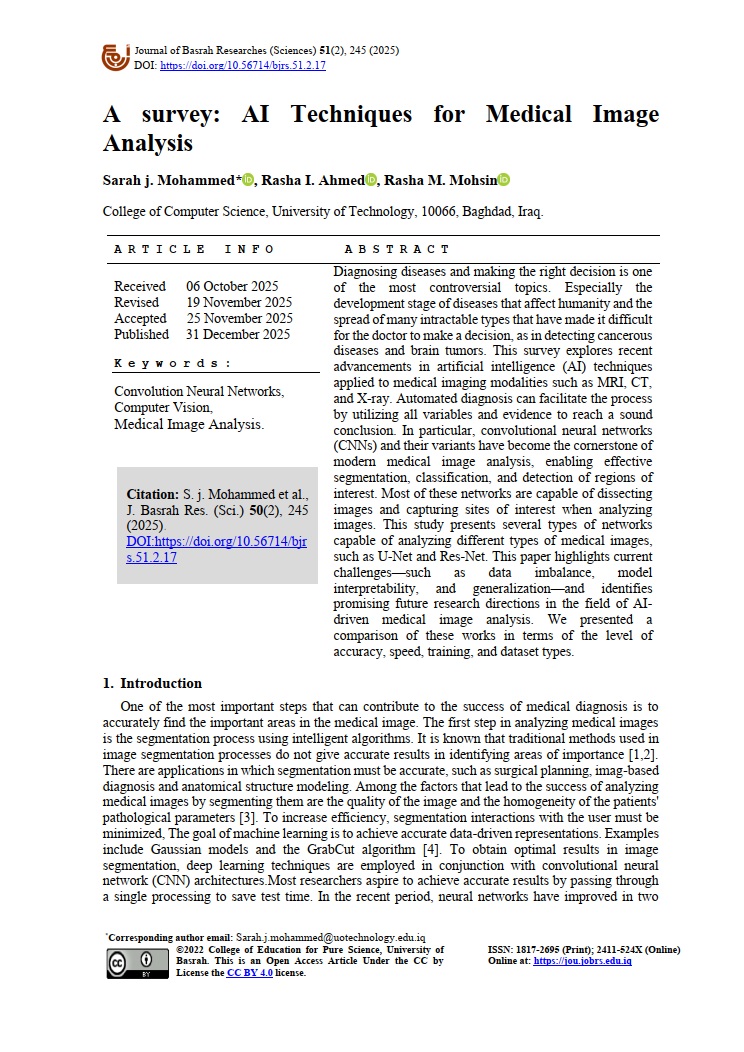
Diagnosing diseases and making the right decision is one of the most controversial topics. Especially the development stage of diseases that affect humanity and the spread of many intractable types that have made it difficult for the doctor to make a decision, as in detecting cancerous diseases and brain tumors. This survey explores recent advancements in artificial intelligence (AI) techniques applied to medical imaging modalities such as MRI, CT, and X-ray. Automated diagnosis can facilitate the process by utilizing all variables and evidence to reach a sound conclusion. In particular, convolutional neural networks (CNNs) and their variants have become the cornerstone of modern medical image analysis, enabling effective segmentation, classification, and detection of regions of interest. Most of these networks are capable of dissecting images and capturing sites of interest when analyzing images. This study presents several types of networks capable of analyzing different types of medical images, such as U-Net and Res-Net. This paper highlights current challenges—such as data imbalance, model interpretability, and generalization—and identifies promising future research directions in the field of AI-driven medical image analysis. We presented a comparison of these works in terms of the level of accuracy, speed, training, and dataset types
Downloads
References
[1] G. Litjens, T. Kooi, B. E. Bejnordi, A. A. A. Setio, F. Ciompi, et al., “A survey on deep learning in medical image analysis,” Medical Image Analysis, vol. 42, pp. 60–88, 2017, doi: 10.1016/j.media.2017.07.005. DOI: https://doi.org/10.1016/j.media.2017.07.005
[2] M. Li, Y. Jiang, et al., “Medical image analysis using deep learning algorithms,” Frontiers in Public Health, vol. 11, 2023, Art. no. 1273253, doi: 10.3389/fpubh.2023.1273253. DOI: https://doi.org/10.3389/fpubh.2023.1273253
[3] Y. Gao, Y. Jiang, Y. Peng, et al., “Medical image segmentation: A comprehensive review of deep learning-based methods,” Tomography, vol. 11, no. 5, 2025, Art. no. 0052, doi: 10.3390/tomography11050052. DOI: https://doi.org/10.3390/tomography11050052
[4] S. Pang, T. Thio, F. Siaw, et al., “Research on improved image segmentation algorithm based on GrabCut,” Electronics, vol. 13, no. 20, 2024, Art. no. 4068, doi: 10.3390/electronics13204068. DOI: https://doi.org/10.3390/electronics13204068
[5] A. Tulbure, et al., “A review on modern defect detection models using DCNNs,” Journal of Advanced Research, vol. 35, pp. 33–48, 2022, doi: 10.1016/j.jare.2021.03.015. DOI: https://doi.org/10.1016/j.jare.2021.03.015
[6] N. Mathew, “Deep learning for image recognition: Enhancing accuracy and efficiency with big data,” M.Sc. thesis, Northumbria Univ., Newcastle upon Tyne, U.K., 2024, doi: 10.13140/RG.2.2.16387.52004.
[7] S. Giri, S. Dutta, et al., “A real-time epidemic alert generation system for rural areas using WBANs and kiosks,” in Proc. Int. Conf. Information Technology (ICIT), 2017, doi: 10.1063/5.0113024. DOI: https://doi.org/10.1109/ICIT.2017.19
[8] P. Mayerhofer, C. H. Napier, et al., “Neural networks can accurately identify individual runners from their foot kinematics, but fail to predict their running performance,” Journal of Biomechanics, vol. 185, 2025, Art. no. 112663, doi: 10.1016/j.jbiomech.2025.112663. DOI: https://doi.org/10.1016/j.jbiomech.2025.112663
[9] G. Montavon, W. Samek, et al., “Methods for interpreting and understanding deep neural networks,” Digital Signal Processing, vol. 73, pp. 1–15, 2018, doi: 10.1016/j.dsp.2017.10.011. DOI: https://doi.org/10.1016/j.dsp.2017.10.011
[10] S. Dutta and M. Roy, “EDOT: Context-aware tracking of similar data patterns of patients for faster diagnoses,” in Proc. 2nd Int. Conf. Electrical, Computer and Communication Technologies (ICECCT), 2017, doi: 10.1109/ICECCT.2017.8117871. DOI: https://doi.org/10.1109/ICECCT.2017.8117871
[11] M. Taye, “Theoretical understanding of convolutional neural network: Concepts, architectures, applications, future directions,” Computation, vol. 11, no. 3, 2023, Art. no. 52, doi: 10.3390/computation11030052. DOI: https://doi.org/10.3390/computation11030052
[12] J. Zhang, H. Wang, et al., “Deep network based on up-and-down blocks using wavelet transform and successive multiscale spatial attention for cloud detection,” Remote Sensing of Environment, vol. 261, 2021, Art. no. 112483, doi: 10.1016/j.rse.2021.112483. DOI: https://doi.org/10.1016/j.rse.2021.112483
[13] W. Gao, Q. Han, et al., “Graph random walk with feature-label space alignment: A multi-label feature selection method,” arXiv preprint, arXiv:2505.23228, 2025, doi: 10.48550/arXiv.2505.23228. DOI: https://doi.org/10.24963/ijcai.2025/575
[14] A. Pinto, P. Mehta, S. Alle, et al., “DeepEdit: Deep editable learning for interactive segmentation of 3D medical images,” arXiv preprint, arXiv:2305.10655, 2023, doi: 10.48550/arXiv.2305.10655.
[15] O. Dorgham, M. Abu Naser, M. H. Ryalat, et al., “U-NetCTS: U-Net deep neural network for fully automatic segmentation of 3D CT DICOM volume,” Journal of the Franklin Institute, 2025, doi: 10.1016/j.smhl.2022.100304. DOI: https://doi.org/10.1016/j.smhl.2022.100304
[16] G. Wang, Z. Zuluaga, W. Li, et al., “DeepIGeoS: A deep interactive geodesic framework for medical image segmentation,” IEEE Trans. Pattern Anal. Mach. Intell., vol. 41, no. 7, pp. 1559–1572, 2018, doi: 10.1109/TPAMI.2018.2840695. DOI: https://doi.org/10.1109/TPAMI.2018.2840695
[17] Y. Zhang, J. Chen, X. Ma, et al., “Interactive medical image annotation using improved attention U-Net with compound geodesic distance,” Expert Systems with Applications, vol. 237, 2024, Art. no. 121282, doi: 10.1016/j.eswa.2023.121282. DOI: https://doi.org/10.1016/j.eswa.2023.121282
[18] S. Pawar, M. Bhushan, et al., “The plant leaf disease diagnosis and spectral data analysis using machine learning: A review,” Int. J. Advanced Science and Technology, vol. 29, 2020, doi: 10.2174/9789815049251122010008. DOI: https://doi.org/10.2174/9789815049251122010008
[19] S. H. Chen, Z. Gamechi, F. Dubost, et al., “An end-to-end approach to segmentation in medical images with CNN and posterior CRF,” Medical Image Analysis, vol. 76, Feb. 2022, Art. no. 102311, doi: 10.1016/j.media.2021.102311. DOI: https://doi.org/10.1016/j.media.2021.102311
[20] A. Salman and W. Al-Jawher, “Image document classification prediction based on SVM and gradient boosting algorithms,” Journal of Port Science Research, vol. 6, no. 4, pp. 55–62, Dec. 2023, doi: 10.36371/port.2023.4.5. DOI: https://doi.org/10.36371/port.2023.4.5
[21] L. Liu, G. Cheng, Q. Quan, et al., “A survey on U-shaped networks in medical image segmentation,” Neurocomputing, vol. 409, pp. 244–258, Jun. 2020, doi: 10.1016/j.neucom.2020.05.070. DOI: https://doi.org/10.1016/j.neucom.2020.05.070
[22] Y. Xin, L. Sun, et al., “U-Net-based medical image segmentation,” Journal of Healthcare Engineering, 2022, Art. no. 4189781, doi: 10.1155/2022/4189781. DOI: https://doi.org/10.1155/2022/4189781
[23] M. Rajchl, M. Lee, O. Oktay, K. Kamnitsas, et al., “DeepCut: Object segmentation from bounding box annotations using convolutional neural networks,” IEEE Trans. Med. Imaging, vol. 36, no. 2, pp. 674–683, 2016, doi: 10.1109/TMI.2016.2621185. DOI: https://doi.org/10.1109/TMI.2016.2621185
[24] J. Redmon and A. Farhadi, “You only look once: Unified, real-time object detection,” in Proc. IEEE Conf. Comput. Vision Pattern Recognit. (CVPR), Las Vegas, NV, USA, 2016, pp. 779–788, doi: 10.1109/CVPR.2016.91. DOI: https://doi.org/10.1109/CVPR.2016.91
[25] F. Prinzi, M. Insalaco, A. Orlando, et al., “A YOLO-based model for breast cancer detection in mammograms,” Cognitive Computation, vol. 16, pp. 107–120, 2023, doi: 10.1007/s12559-023-10189-6. DOI: https://doi.org/10.1007/s12559-023-10189-6
[26] K. Gunasekaran, “Leveraging object detection for the identification of lung cancer,” arXiv preprint, arXiv:2305.15813, 2023, doi: 10.48550/arXiv.2305.15813.
[27] H. Chegraoui, C. Philippe, V. Dangouloff-Ros, et al., “Object detection improves tumour segmentation in MR images of rare brain tumours,” Cancers, vol. 13, no. 23, 2021, Art. no. 6113, doi: 10.3390/cancers13236113. DOI: https://doi.org/10.3390/cancers13236113
[28] G. Wang, W. Li, M. Zuluaga, R. Pratt, et al., “Interactive medical image segmentation using deep learning with image-specific fine tuning,” IEEE Trans. Med. Imaging, vol. 37, no. 7, pp. 1562–1573, Jul. 2018, doi: 10.1109/TMI.2018.2791721.
[29] A. Plaksyvyi, M. Paszkowska, et al., “A comparative analysis of image segmentation using classical and deep learning approaches,” Advances in Science and Technology Research Journal, vol. 17, no. 6, pp. 127–139, 2023, doi: 10.12913/22998624/172771. DOI: https://doi.org/10.12913/22998624/172771
[30] G. Wang, W. Li, M. Zuluaga, et al., “Interactive medical image segmentation using deep learning with image-specific fine tuning,” IEEE Trans. Med. Imaging, vol. 37, no. 7, pp. 1562–1573, Jul. 2018, doi: 10.1109/TMI.2018.2791721. DOI: https://doi.org/10.1109/TMI.2018.2791721
[31] D. Fan, T. Zhou, G. Ji, et al., “Inf-Net: Automatic COVID-19 lung infection segmentation from CT images,” IEEE Trans. Med. Imaging, vol. 39, no. 8, pp. 2626–2637, Aug. 2020, doi: 10.1109/TMI.2020.2996645. DOI: https://doi.org/10.1109/TMI.2020.2996645
[32] Q. Dou, H. Chen, Y. Jin, et al., “3D deeply supervised network for automatic liver segmentation from CT volumes,” in Proc. MICCAI, Springer, 2016, doi: 10.48550/arXiv.1607.00582. DOI: https://doi.org/10.1007/978-3-319-46723-8_18
[33] Z. Zhang, H. Fu, H. Dai, et al., “ET-Net: A generic edge-attention guidance network for medical image segmentation,” arXiv preprint, arXiv:1907.10936, 2019, doi: 10.48550/arXiv.1907.10936. DOI: https://doi.org/10.1007/978-3-030-32239-7_49
[34] X. Qin, “Transfer learning with edge attention for prostate MRI segmentation,” Ph.D. dissertation, East China Univ. of Science and Technology, 2019, doi: 10.48550/arXiv.1912.09847.
[35] U. R. Ker, L. Wang, J. Rao, and T. Lim, “Deep learning applications in medical image analysis,” IEEE Access, vol. 5, pp. 142–151, 2017, doi: 10.1109/ACCESS.2017.2788044. DOI: https://doi.org/10.1109/ACCESS.2017.2788044
[36] L. D. Griffin, A. C. F. Colchester, S. A. Röll, and C. S. Studholme, “Hierarchical segmentation satisfying constraints,” in Proc. British Machine Vision Conf., 1994, pp. 135–144, doi: 10.5244/C.8.13. DOI: https://doi.org/10.5244/C.8.13
[37] G. Wang, X. Liu, C. Li, et al., “A noise-robust framework for automatic segmentation of COVID-19 pneumonia lesions from CT images,” IEEE Trans. Med. Imaging, vol. 39, no. 8, pp. 2653–2663, Aug. 2020, doi: 10.1109/TMI.2020.3000314. DOI: https://doi.org/10.1109/TMI.2020.3000314
[38] T. Khanh, D. Dao, et al., “Enhancing U-Net with spatial-channel attention gate for abnormal tissue segmentation in medical imaging,” Applied Sciences, vol. 10, no. 17, 2020, Art. no. 5729, doi: 10.3390/app10175729. DOI: https://doi.org/10.3390/app10175729
[39] S. Pang, C. Pang, et al., “SpineParseNet: Spine parsing for volumetric MR image by a two-stage segmentation framework with semantic image representation,” IEEE Trans. Med. Imaging, vol. 40, no. 1, pp. 262–273, 2021, doi: 10.1109/TMI.2020.3025087. DOI: https://doi.org/10.1109/TMI.2020.3025087
[40] Y. Ji, H. Zhang, et al., “CNN-based encoder-decoder networks for salient object detection: A comprehensive review and recent advances,” Information Sciences, vol. 546, pp. 835–857, Feb. 2021, doi: 10.1016/j.ins.2020.09.003. DOI: https://doi.org/10.1016/j.ins.2020.09.003
[41] I. Goodfellow, Y. Bengio, and A. Courville, Deep Learning. Cambridge, MA, USA: MIT Press, 2016.
[42] X. Chen, Y. Lian, et al., “Supervised edge attention network for accurate image instance segmentation,” in Proc. ECCV Workshops, 2020, doi: 10.1007/978-3-030-58583-9_37. DOI: https://doi.org/10.1007/978-3-030-58583-9_37
[43] E. Hodneland, E. Hanson, A. Munthe-Kaas, et al., “Physical models for simulation and reconstruction of human tissue deformation fields in dynamic MRI,” IEEE Trans. Biomed. Eng., vol. 63, no. 10, pp. 2203–2212, Oct. 2016, doi: 10.1109/TBME.2015.2514262. DOI: https://doi.org/10.1109/TBME.2015.2514262
[44] P. Chatterjee and S. Dutta, “A survey on techniques used in medical imaging processing,” J. Physics: Conf. Series, vol. 2089, no. 1, 2021, Art. no. 012013, doi: 10.1088/1742-6596/2089/1/012013. DOI: https://doi.org/10.1088/1742-6596/2089/1/012013
[45] D. L. Collins, A. P. Zijdenbos, et al., “Design and construction of a realistic digital brain phantom,” IEEE Trans. Med. Imaging, vol. 17, no. 3, pp. 463–468, Jun. 1998, doi: 10.1109/42.712135. DOI: https://doi.org/10.1109/42.712135
[46] L. Zhong, Y. Chen, X. Zhang, et al., “Flexible prediction of CT images from MRI data through improved neighborhood anchored regression for PET attenuation correction,” IEEE J. Biomed. Health Inform., vol. 24, no. 4, pp. 1114–1124, Apr. 2020, doi: 10.1109/JBHI.2019.2927368. DOI: https://doi.org/10.1109/JBHI.2019.2927368
[47] Z. Al-Ameen, “Contrast enhancement of medical images using statistical methods with image processing concepts,” in Proc. 6th Int. Eng. Conf. Sustainable Technology and Development (IEC), 2020, pp. 169–173, doi: 10.1109/IEC49899.2020.9122925. DOI: https://doi.org/10.1109/IEC49899.2020.9122925
[48] B. Codella, K. Connah, et al., “Analysis of the ISIC image datasets, usage, benchmarks and recommendations,” Medical Image Analysis, vol. 75, 2022, Art. no. 102305, doi: 10.1016/j.media.2021.102305. DOI: https://doi.org/10.1016/j.media.2021.102305
[49] R. Asif, H. Maqsood, and I. Nadeem, “Enhanced MRI brain tumor detection using deep learning with explainable AI SHAP analysis,” Scientific Reports, vol. 15, 2025, Art. no. 14901, doi: 10.1038/s41598-025-14901-4. DOI: https://doi.org/10.1038/s41598-025-14901-4
[50] J. Radhika, L. Marta, et al., “Three-dimensional end-to-end deep learning for brain MRI analysis,” arXiv preprint, arXiv:2506.23916, 2025.
[51] O. Ebenezer and B. Prince, “Computer-aided diagnostics of heart disease risk prediction using boosting SVM,” Journal of Healthcare Engineering, 2021, Art. no. 3152618, doi: 10.1155/2021/3152618. DOI: https://doi.org/10.1155/2021/3152618
[52] A. Parnian, “Capsule networks for brain tumor classification based on MRI images,” in Proc. IEEE ICASSP, 2019, doi: 10.1109/ICASSP.2019.8683759. DOI: https://doi.org/10.1109/ICASSP.2019.8683759
[53] S. Bam, W. Alongbar, et al., “Transfer learning based detection of retina damage using OCT images,” in Computational Methods and Deep Learning for Ophthalmology, pp. 71–88, 2023, doi: 10.1016/B978-0-323-95415-0.00002-4. DOI: https://doi.org/10.1016/B978-0-323-95415-0.00002-4
[54] D. Kumar and D. Satyanarayana, “MRI brain tumor detection using optimal possibilistic fuzzy C-means clustering and adaptive KNN,” Journal of Ambient Intelligence and Humanized Computing, vol. 12, pp. 2867–2880, 2021, doi: 10.1007/s12652-020-02444-7. DOI: https://doi.org/10.1007/s12652-020-02444-7
[55] Z. H. Abed Al-Rahman Ali, “Automatic lung cancer classification in CT-scan images using CNN,” M.Sc. thesis, Dept. Computer Science, College of Computer Science & Information Technology, University of Kerbala, Kerbala, Iraq, 2023.
[56] M. Mostafa, M. Zakariah, et al., “Brain tumor segmentation using deep learning on MRI images,” Diagnostics, vol. 13, 2023, Art. no. 1562, doi: 10.3390/diagnostics13091562. DOI: https://doi.org/10.3390/diagnostics13091562
[57] Y. Nasr, R. Fernandez, et al., “Automated lung cancer diagnosis applying Butterworth filtering and sparse CNN to LUNA16 CT images,” Journal of Imaging, vol. 10, 2024, Art. no. 168, doi: 10.3390/jimaging10070168. DOI: https://doi.org/10.3390/jimaging10070168
[58] M. Fayad, I. Diamant, et al., “GAN-based synthetic medical image augmentation for CNN performance in liver lesion classification,” Neurocomputing, vol. 294, pp. 118–127, 2018, doi: 10.1016/j.neucom.2018.09.013. DOI: https://doi.org/10.1016/j.neucom.2018.09.013
Downloads
Published
Issue
Section
License
Copyright (c) 2025 Basrah Researches Sciences

This work is licensed under a Creative Commons Attribution 4.0 International License.
This journal is licensed under the Creative Commons Attribution 4.0 International License (CC BY 4.0).
Under this license, users are permitted to read, download, copy, distribute, print, search, link to the full texts of articles, and create derivative works, including for commercial purposes, provided that appropriate credit is given to the original author(s) and the source.
The copyright of all published articles is transferred to the College of Education for Pure Sciences, University of Basrah. Proper attribution must include the article title, author name(s), journal name, DOI, and a link to the Creative Commons license.