Evaluation of sclerostin and oxidative stress markers in coronary artery disease patients
DOI:
https://doi.org/10.56714/bjrs.51.2.22Keywords:
Sclerostin, Myeloperoxidase, Arylesterase, Malondialdehyde, Albumin, Coronary Heart DiseaseAbstract
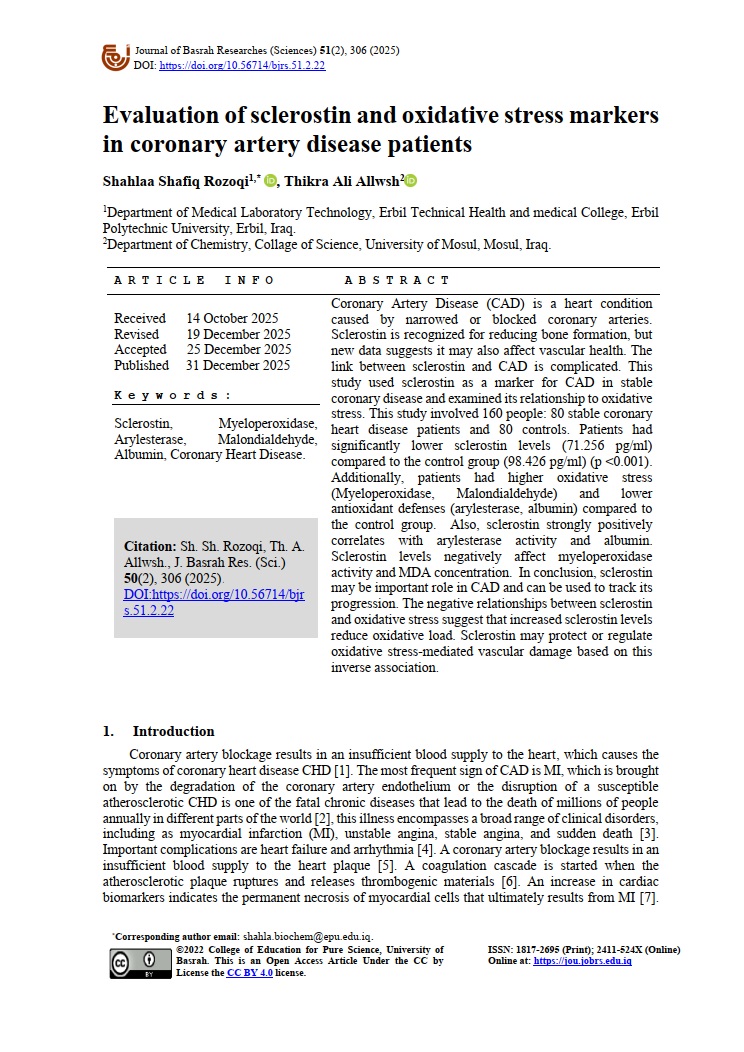
Coronary Artery Disease (CAD) is a heart condition caused by narrowed or blocked coronary arteries. Sclerostin is recognized for reducing bone formation, but new data suggests it may also affect vascular health. The link between sclerostin and CAD is complicated. This study used sclerostin as a marker for CAD in stable coronary disease and examined its relationship to oxidative stress. This study involved 160 people: 80 stable coronary heart disease patients and 80 controls. Patients had significantly lower sclerostin levels (71.256 pg/ml) compared to the control group (98.426 pg/ml) (p <0.001). Additionally, patients had higher oxidative stress (Myeloperoxidase, Malondialdehyde) and lower antioxidant defenses (arylesterase, albumin) compared to the control group. Also, sclerostin strongly positively correlates with arylesterase activity and albumin. Sclerostin levels negatively affect myeloperoxidase activity and MDA concentration. In conclusion, sclerostin may be important role in CAD and can be used to track its progression. The negative relationships between sclerostin and oxidative stress suggest that increased sclerostin levels reduce oxidative load. Sclerostin may protect or regulate oxidative stress-mediated vascular damage based on this inverse association
Downloads
References
[1] U. Ralapanawa and R. Sivakanesan, “Epidemiology and the magnitude of coronary artery disease and acute coronary syndrome: A narrative review,” J. Epidemiol. Glob. Health, vol. 11, no. 2, pp. 169–177, Jun. 2021, doi: 10.2991/jegh.k.201217.001. DOI: https://doi.org/10.2991/jegh.k.201217.001
[2] M. Di Cesare et al., “The heart of the world,” Global Heart, vol. 19, no. 1, Art. no. 11, 2024, doi: 10.5334/gh.1288. DOI: https://doi.org/10.5334/gh.1288
[3] S. Mendis et al., “World Health Organization definition of myocardial infarction: 2008–09 revision,” Int. J. Epidemiol., vol. 40, no. 1, pp. 139–146, 2011, doi: 10.1093/ije/dyq165. DOI: https://doi.org/10.1093/ije/dyq165
[4] F. Bessière, B. Mondésert, M. A. Chaix, and P. Khairy, “Arrhythmias in adults with congenital heart disease and heart failure,” Heart Rhythm O2, vol. 2, no. 6, pt. B, pp. 744–753, 2021, doi: 10.1016/j.hroo.2021.10.005. DOI: https://doi.org/10.1016/j.hroo.2021.10.005
[5] D. J. Medina-Leyte et al., “Endothelial dysfunction, inflammation and coronary artery disease: Potential biomarkers and promising therapeutical approaches,” Int. J. Mol. Sci., vol. 22, no. 8, Art. no. 3850, 2021, doi: 10.3390/ijms22083850. DOI: https://doi.org/10.3390/ijms22083850
[6] R. H. Olie, P. E. J. van der Meijden, and H. Ten Cate, “The coagulation system in atherothrombosis: Implications for new therapeutic strategies,” Res. Pract. Thromb. Haemost., vol. 2, no. 2, pp. 188–198, 2018, doi: 10.1002/rth2.12080. DOI: https://doi.org/10.1002/rth2.12080
[7] G. W. Reed, J. E. Rossi, and C. P. Cannon, “Acute myocardial infarction,” Lancet, vol. 389, pp. 197–210, 2017, doi: 10.1016/S0140-6736(16)30677-8. DOI: https://doi.org/10.1016/S0140-6736(16)30677-8
[8] S. Y. Lee, C. T. Chao, J. W. Huang, and K. C. Huang, “Vascular calcification as an underrecognized risk factor for frailty in community-dwelling elderly individuals,” J. Am. Heart Assoc., vol. 9, no. 18, Art. no. e017308, 2020, doi: 10.1161/JAHA.120.017308. DOI: https://doi.org/10.1161/JAHA.120.017308
[9] T.-L. Chuang, M. Koo, and Y.-F. Wang, “Association of bone mineral density and coronary artery calcification in patients with osteopenia and osteoporosis,” Diagnostics, vol. 10, no. 9, Art. no. 699, 2020, doi: 10.3390/diagnostics10090699. DOI: https://doi.org/10.3390/diagnostics10090699
[10] L. Aaltonen et al., “Association between bone mineral metabolism and vascular calcification in end-stage renal disease,” BMC Nephrology, vol. 23, Art. no. 12, 2022, doi: 10.1186/s12882-021-02652-z. DOI: https://doi.org/10.1186/s12882-021-02652-z
[11] J. Golledge and S. Thanigaimani, “Role of sclerostin in cardiovascular disease,” Arterioscler. Thromb. Vasc. Biol., vol. 42, no. 7, pp. e187–e202, 2022, doi: 10.1161/ATVBAHA.122.317635. DOI: https://doi.org/10.1161/ATVBAHA.122.317635
[12] B. Javaheri et al., “Sost haploinsufficiency provokes peracute lethal cardiac tamponade without rescuing osteopenia in a mouse model,” Am. J. Pathol., vol. 189, pp. 753–761, 2019, doi: 10.1016/j.ajpath.2018.12.007. DOI: https://doi.org/10.1016/j.ajpath.2018.12.007
[13] A. De Maré et al., “Sclerostin protects against vascular calcification development in mice,” J. Bone Miner. Res., vol. 37, pp. 687–699, 2022, doi: 10.1002/jbmr.4503. DOI: https://doi.org/10.1002/jbmr.4503
[14] F. Marini et al., “Role of Wnt signaling and sclerostin in bone and as therapeutic targets in skeletal disorders,” Osteoporosis International, vol. 34, no. 2, pp. 213–238, 2023, doi: 10.1007/s00198-022-06523-7.
[15] S. Foulquier et al., “WNT signaling in cardiac and vascular disease,” Pharmacol. Rev., vol. 70, no. 1, pp. 68–141, 2018, doi: 10.1124/pr.117.013896. DOI: https://doi.org/10.1124/pr.117.013896
[16] M. Myszko et al., “The dual role of oxidative stress in atherosclerosis and coronary artery disease,” Antioxidants, vol. 14, no. 3, Art. no. 275, 2025, doi: 10.3390/antiox14030275. DOI: https://doi.org/10.3390/antiox14030275
[17] J. Checa and J. M. Aran, “Reactive oxygen species: Drivers of physiological and pathological processes,” J. Inflamm. Res., vol. 13, pp. 1057–1073, 2020, doi: 10.2147/JIR.S275595. DOI: https://doi.org/10.2147/JIR.S275595
[18] X. Yang et al., “Regulation of oxidative stress in coronary heart disease by traditional Chinese medicine,” Oxid. Med. Cell. Longev., vol. 2019, Art. no. 3231424, 2019, doi: 10.1155/2019/3231424. DOI: https://doi.org/10.1155/2019/3231424
[19] M. Batty, M. R. Bennett, and E. Yu, “The role of oxidative stress in atherosclerosis,” Cells, vol. 11, no. 23, Art. no. 3843, 2022, doi: 10.3390/cells11233843. DOI: https://doi.org/10.3390/cells11233843
[20] B. Pang et al., “Vascular endothelial injury-associated diseases: Focus on mitochondrial dysfunction,” Angiogenesis, vol. 27, no. 4, pp. 623–639, 2024. DOI: https://doi.org/10.1007/s10456-024-09938-4
[21] S. Simantiris et al., “Perivascular fat: A novel risk factor for coronary artery disease,” Diagnostics, vol. 14, no. 16, Art. no. 1830, 2024, doi: 10.3390/diagnostics14161830. DOI: https://doi.org/10.3390/diagnostics14161830
[22] W.-Q. Liu et al., “Myeloperoxidase-derived hypochlorous acid promotes endothelial senescence,” Biochem. Biophys. Res. Commun., vol. 467, no. 4, pp. 859–865, 2015, doi: 10.1016/j.bbrc.2015.10.053. DOI: https://doi.org/10.1016/j.bbrc.2015.10.053
[23] D. Kunachowicz et al., “Modulatory effect of lifestyle-related factors on paraoxonase-1 activity,” Int. J. Environ. Res. Public Health, vol. 20, no. 4, Art. no. 2813, 2023, doi: 10.3390/ijerph20042813. DOI: https://doi.org/10.3390/ijerph20042813
[24] D. A. Belinskaia, P. A. Voronina, and N. V. Goncharov, “Integrative role of albumin,” J. Evol. Biochem. Physiol., vol. 57, no. 6, pp. 1419–1448, 2021, doi: 10.1134/S002209302106020X. DOI: https://doi.org/10.1134/S002209302106020X
[25] M. K. Tuck et al., “Standard operating procedures for serum and plasma collection,” J. Proteome Res., vol. 8, no. 1, pp. 113–117, 2009, doi: 10.1021/pr800545q. DOI: https://doi.org/10.1021/pr800545q
[26] P. Kumar et al., “NADH-oxidase, NADPH-oxidase and myeloperoxidase activity in visceral leishmaniasis,” J. Med. Microbiol., vol. 51, no. 10, pp. 832–836, 2002. DOI: https://doi.org/10.1099/0022-1317-51-10-832
[27] T. Allwsh and R. Jasim, “Arylesterase activity in atherosclerotic patients,” Rafidain J. Sci., vol. 19, no. 2, pp. 143–157, 2008.
[28] B. Guidet and S. V. Shah, “Enhanced in vivo H₂O₂ generation in renal failure,” Am. J. Physiol. Renal Physiol., vol. 257, no. 3, pp. F440–F445, 1989, doi: 10.1152/ajprenal.1989.257.3.F440. DOI: https://doi.org/10.1152/ajprenal.1989.257.3.F440
[29] L. Y. Milovanova et al., “FGF-23/sKlotho/sclerostin ratio disturbance in ESRD,” Ter. Arkh., vol. 90, no. 6, pp. 48–54, 2018, doi: 10.26442/terarkh201890648-54. DOI: https://doi.org/10.26442/terarkh201890648-54
[30] W. He et al., “Serum sclerostin and adverse outcomes after PCI,” Aging Clin. Exp. Res., vol. 32, no. 10, pp. 2065–2072, 2020, doi: 10.1007/s40520-019-01393-2. DOI: https://doi.org/10.1007/s40520-019-01393-2
[31] F. Burger et al., “Reduced sclerostin expression in atherosclerotic plaques,” J. Am. Heart Assoc., vol. 13, 2024, doi: 10.1161/JAHA.123.033038. DOI: https://doi.org/10.1161/JAHA.123.033038
[32] F. Marini et al., “Role of Wnt signaling and sclerostin,” Osteoporosis International, vol. 34, no. 2, pp. 213–238, 2023, doi: 10.1007/s00198-022-06523-7. DOI: https://doi.org/10.1007/s00198-022-06523-7
[33] J. Ohan et al., “Coronary artery calcification,” in StatPearls. Treasure Island, FL: StatPearls Publishing, 2025.
[34] M. Zuin et al., “Paraoxonase-1 arylesterase activity in coronary artery disease,” Disease Markers, vol. 2022, Art. no. 4264314, 2022, doi: 10.1155/2022/4264314. DOI: https://doi.org/10.1155/2022/4264314
[35] G. L. Erre et al., “Paraoxonase/arylesterase activity and rheumatoid arthritis,” Antioxidants, vol. 11, no. 12, Art. no. 2317, 2022, doi: 10.3390/antiox11122317. DOI: https://doi.org/10.3390/antiox11122317
[36] C. L. Hawkins and M. J. Davies, “Role of myeloperoxidase in inflammation-induced tissue damage,” Free Radic. Biol. Med., vol. 172, pp. 633–651, 2021, doi: 10.1016/j.freeradbiomed.2021.07.007. DOI: https://doi.org/10.1016/j.freeradbiomed.2021.07.007
[37] M. Cheng et al., “Association of myeloperoxidase with coronary artery disease severity,” Exp. Ther. Med., vol. 20, no. 2, pp. 1532–1540, 2020, doi: 10.3892/etm.2020.8817. DOI: https://doi.org/10.3892/etm.2020.8817
[38] M. E. Elsetiha et al., “Serum malondialdehyde as predictor for coronary artery disease severity,” Egypt. J. Hosp. Med., vol. 95, no. 1, pp. 2206–2211, 2024, doi: 10.21608/ejhm.2024.360963. DOI: https://doi.org/10.21608/ejhm.2024.360963
[39] H. Asfandiyar et al., “Serum malondialdehyde as a biomarker for coronary artery disease,” Cureus, vol. 16, no. 9, Art. no. e69756, 2024, doi: 10.7759/cureus.69756. DOI: https://doi.org/10.7759/cureus.69756
[40] S. Arques, “Serum albumin and cardiovascular disease,” Eur. J. Intern. Med., vol. 80, pp. 122–123, 2020. DOI: https://doi.org/10.1016/j.ejim.2020.07.019
[41] L. Azouaou et al., “Oxidative stress markers in chronic kidney disease,” Arch. Med. Sci. Atheroscler. Dis., vol. 9, Art. no. e183, 2024, doi: 10.5114/amsad/192427. DOI: https://doi.org/10.5114/amsad/192427
[42] Y. Chen et al., “Heterogeneous monocytes in coronary artery disease,” Front. Immunol., vol. 16, Art. no. 1428978, 2025, doi: 10.3389/fimmu.2025.1428978. DOI: https://doi.org/10.3389/fimmu.2025.1428978
[43] S. Bassu et al., “Paraoxonase and arylesterase activity in psoriatic patients,” Clin. Exp. Med., vol. 23, no. 2, pp. 301–311, 2023, doi: 10.1007/s10238-022-00818-z. DOI: https://doi.org/10.1007/s10238-022-00818-z
[44] M. Vavlukis et al., “Paraoxonase 1 gene polymorphisms in atherosclerosis,” Front. Genet., vol. 13, Art. no. 966413, 2022, doi: 10.3389/fgene.2022.966413. DOI: https://doi.org/10.3389/fgene.2022.966413
[45] K. S. Patil and R. R. Wadekar, “Lipid peroxidation as a signaling mechanism,” in Accenting Lipid Peroxidation. London, U.K.: IntechOpen, 2021, p. 13, doi: 10.5772/intechopen.99706. DOI: https://doi.org/10.5772/intechopen.99706
Downloads
Published
Issue
Section
License
Copyright (c) 2025 Basrah Researches Sciences

This work is licensed under a Creative Commons Attribution 4.0 International License.
This journal is licensed under the Creative Commons Attribution 4.0 International License (CC BY 4.0).
Under this license, users are permitted to read, download, copy, distribute, print, search, link to the full texts of articles, and create derivative works, including for commercial purposes, provided that appropriate credit is given to the original author(s) and the source.
The copyright of all published articles is transferred to the College of Education for Pure Sciences, University of Basrah. Proper attribution must include the article title, author name(s), journal name, DOI, and a link to the Creative Commons license.