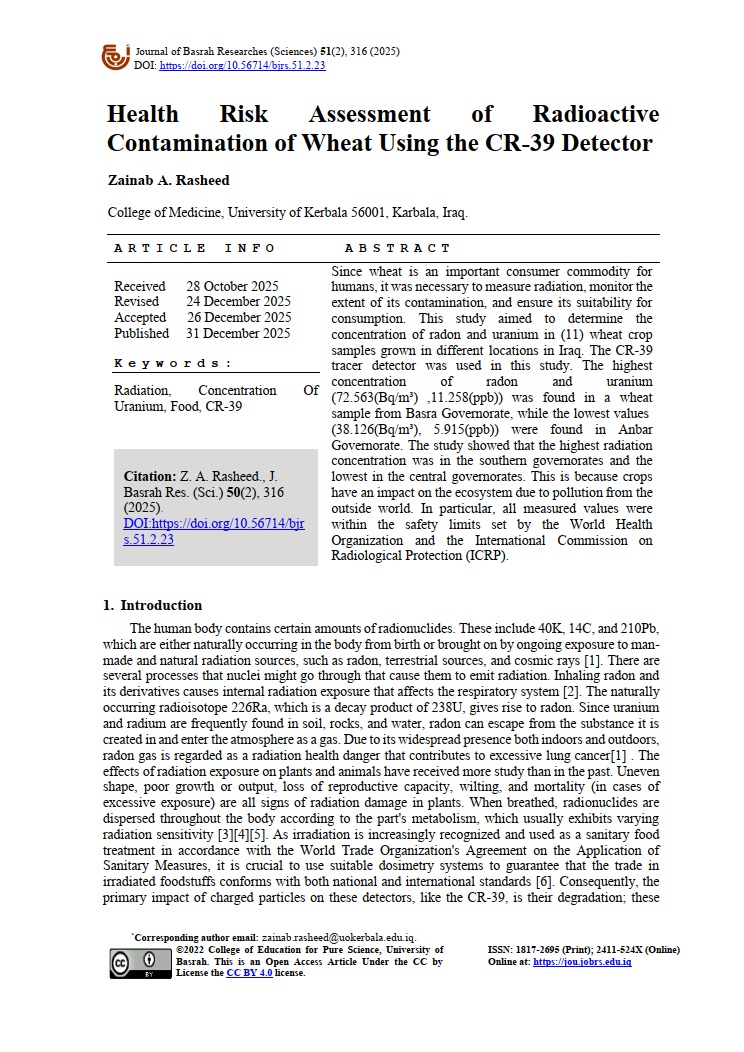
Health Risk Assessment of Radioactive Contamination of Wheat Using the CR-39 Detector
DOI:
https://doi.org/10.56714/bjrs.51.2.23Keywords:
Radiation, Concentration Of Uranium, Food, CR-39Abstract
Since wheat is an important consumer commodity for humans, it was necessary to measure radiation, monitor the extent of its contamination, and ensure its suitability for consumption. This study aimed to determine the concentration of radon and uranium in (11) wheat crop samples grown in different locations in Iraq. The CR-39 tracer detector was used in this study. The highest concentration of radon and uranium (72.563(Bq/m³) ,11.258(ppb)) was found in a wheat sample from Basra Governorate, while the lowest values (38.126(Bq/m³), 5.915(ppb)) were found in Anbar Governorate. The study showed that the highest radiation concentration was in the southern governorates and the lowest in the central governorates. This is because crops have an impact on the ecosystem due to pollution from the outside world. In particular, all measured values were within the safety limits set by the World Health Organization and the International Commission on Radiological Protection (ICRP)
Downloads
References
[1] A. N. Jameel, “Measurements of radon concentrations in some dried fruit and grain samples by CR-39 nuclear track detector,” Iraqi Journal of Science, vol. 63, no. 2, pp. 517–523, 2022, DOI: 10.24996/ijs.2022.63.2.9. DOI: https://doi.org/10.24996/ijs.2022.63.2.9
[2] E. M. Rasheed, “Determination the concentrations of radon gas and exhalation rate in some phosphate fertilizer using CR-39 track detector,” Iraqi Journal of Physics, vol. 15, no. 32, pp. 136–144, 2017, DOI: 10.30723/ijp.v15i32.164. DOI: https://doi.org/10.30723/ijp.v15i32.164
[3] A. A. Ridha, A. N. Jameel, and N. F. Kadhim, “Transfer factor of natural radionuclides from soil to silhouette plants using gamma spectroscopy,” in AIP Conference Proceedings, AIP Publishing LLC, 2020, Art. no. 020124, DOI: 10.1063/5.0000316. DOI: https://doi.org/10.1063/5.0000316
[4] H. N. Azeez, M. H. Kheder, M. Y. Slewa, and S. Y. Sleeman, “Radon concentration measurement in Ainkawa region using solid state nuclear track detector,” Iraqi Journal of Science, pp. 482–488, 2018.
[5] UNSCEAR, Sources, Effects and Risks of Ionizing Radiation, vol. I. United Nations Scientific Committee on the Effects of Atomic Radiation, 2017.
[6] S. Y. Y. Leung, D. Nikezic, J. K. C. Leung, and K. N. Yu, “Derivation of V function for LR 115 SSNTD from its sensitivity to 220Rn in a diffusion chamber,” Applied Radiation and Isotopes, vol. 65, no. 3, pp. 313–317, 2007, DOI: 10.1016/j.apradiso.2006.08.006. DOI: https://doi.org/10.1016/j.apradiso.2006.08.006
[7] A. A. Aziz, “Evaluation of radioactivity of cereals and legumes using a nuclear impact detector CN-85,” Iraqi Journal of Physics, vol. 16, no. 38, pp. 139–146, 2018, DOI: 10.30723/ijp.v16i38.16. DOI: https://doi.org/10.30723/ijp.v16i38.16
[8] N. P. Singh, M. Singh, S. Singh, and H. S. Virk, “Uranium estimation in Siwalik vertebrate fossil bones using SSTD,” International Journal of Radiation Applications and Instrumentation Part D: Nuclear Tracks and Radiation Measurements, vol. 12, no. 1–6, pp. 793–796, 1986, DOI: 10.1016/1359-0189(86)90704-1. DOI: https://doi.org/10.1016/1359-0189(86)90704-1
[9] K. N. Yu, V. S. Y. Koo, and Z. J. Guan, “A simple and versatile 222Rn/220Rn exposure chamber,” Nuclear Instruments and Methods in Physics Research Section A, vol. 481, no. 1–3, pp. 749–755, 2002, DOI: 10.1016/S0168-9002(01)01418-8. DOI: https://doi.org/10.1016/S0168-9002(01)01418-8
[10] Y. S. Mayya, K. P. Eappen, and K. S. V. Nambi, “Methodology for mixed field inhalation dosimetry in monazite areas using a twin-cup dosemeter with three track detectors,” Radiation Protection Dosimetry, vol. 77, no. 3, pp. 177–184, 1998, DOI: 10.1093/oxfordjournals.rpd.a032308. DOI: https://doi.org/10.1093/oxfordjournals.rpd.a032308
[11] R. Barillon, D. Klein, A. Chambaudet, and C. Devillard, “Comparison of effectiveness of three radon detectors (LR115, CR39 and silicon diode pin) placed in a cylindrical device, theory and experimental techniques,” Nuclear Tracks and Radiation Measurements, vol. 22, no. 1–4, pp. 281–282, 1993, DOI: 10.1016/0969-8078(93)90067-E. DOI: https://doi.org/10.1016/0969-8078(93)90067-E
[12] M. H. Kheder and H. N. Azeez, “Measurement of uranium concentrations in the soil samples of Nineveh Province, Iraq using CR-39 detector,” Proceedings of the Pakistan Academy of Sciences A: Physical and Computational Sciences, vol. 61, no. 4, pp. 317–323, 2024, DOI: 10.53560/PPASA(61-4)677. DOI: https://doi.org/10.53560/PPASA(61-4)677
[13] G. Somogyi, A.-F. Hafez, I. Hunyadi, and M. Toth-Szilagyi, “Measurement of exhalation and diffusion parameters of radon in solids by plastic track detectors,” International Journal of Radiation Applications and Instrumentation Part D: Nuclear Tracks and Radiation Measurements, vol. 12, no. 1–6, pp. 701–704, 1986, DOI: 10.1016/1359-0189(86)90683-7. DOI: https://doi.org/10.1016/1359-0189(86)90683-7
[14] M. H. Kheder, A. M. Ahmad, H. N. Azeez, and I. F. Mustafa, “Radium and uranium concentrations of powder juice in the Iraq markets using CR-39 detector,” Journal of University of Babylon for Pure and Applied Sciences, pp. 341–349, 2019.
[15] M. F. L’Annunziata, Radioactivity: Introduction and History, from the Quantum to Quarks. Elsevier, 2016.
[16] M. H. Kheder, L. A. Najam, and H. N. Azeez, “Long-lived alpha emitters concentrations in the spices consumed in Iraq using CR-39 detector,” Journal of University of Babylon for Pure and Applied Sciences, pp. 274–283, 2020.
[17] M. H. Kheder, A. M. Ahmad, H. N. Azeez, M. Y. Slewa, B. A. Badr, and S. Y. Sleeman, “Radon and uranium concentration in groundwater of Nineveh plain region in Iraq,” Journal of Physics: Conference Series, vol. 1234, no. 1, Art. no. 012033, 2019, DOI: 10.1088/1742-6596/1234/1/012033. DOI: https://doi.org/10.1088/1742-6596/1234/1/012033
[18] E. H. Abdelfadeel et al., “Relationship between radioactivity and toxicity in some medicinal plants,” Scientific Reports, vol. 13, Art. no. 10952, 2023, DOI: 10.1038/s41598-023-37403-7. DOI: https://doi.org/10.1038/s41598-023-37403-7
[19] M. H. Kheder et al., “Radioactivity concentrations in barley and wheat crops in Nineveh plain region in Iraq,” International Journal of Nuclear Energy Science and Technology, vol. 14, no. 1, pp. 50–60, 2020, DOI: 10.1504/IJNEST.2020.108804. DOI: https://doi.org/10.1504/IJNEST.2020.108804
[20] A. Y. Kadhim, K. H. Al-Ataya, and M. Sh. Aswood, “Distribution and uptake of uranium in rice and wheat from soil samples collected from Al-Diwaniyah, Iraq,” Journal of Physics: Conference Series, vol. 1897, no. 1, Art. no. 012065, 2021, DOI: 10.1088/1742-6596/1897/1/012065. DOI: https://doi.org/10.1088/1742-6596/1897/1/012065
Downloads
Published
Issue
Section
License
Copyright (c) 2025 Basrah Researches Sciences

This work is licensed under a Creative Commons Attribution 4.0 International License.
This journal is licensed under the Creative Commons Attribution 4.0 International License (CC BY 4.0).
Under this license, users are permitted to read, download, copy, distribute, print, search, link to the full texts of articles, and create derivative works, including for commercial purposes, provided that appropriate credit is given to the original author(s) and the source.
The copyright of all published articles is transferred to the College of Education for Pure Sciences, University of Basrah. Proper attribution must include the article title, author name(s), journal name, DOI, and a link to the Creative Commons license.