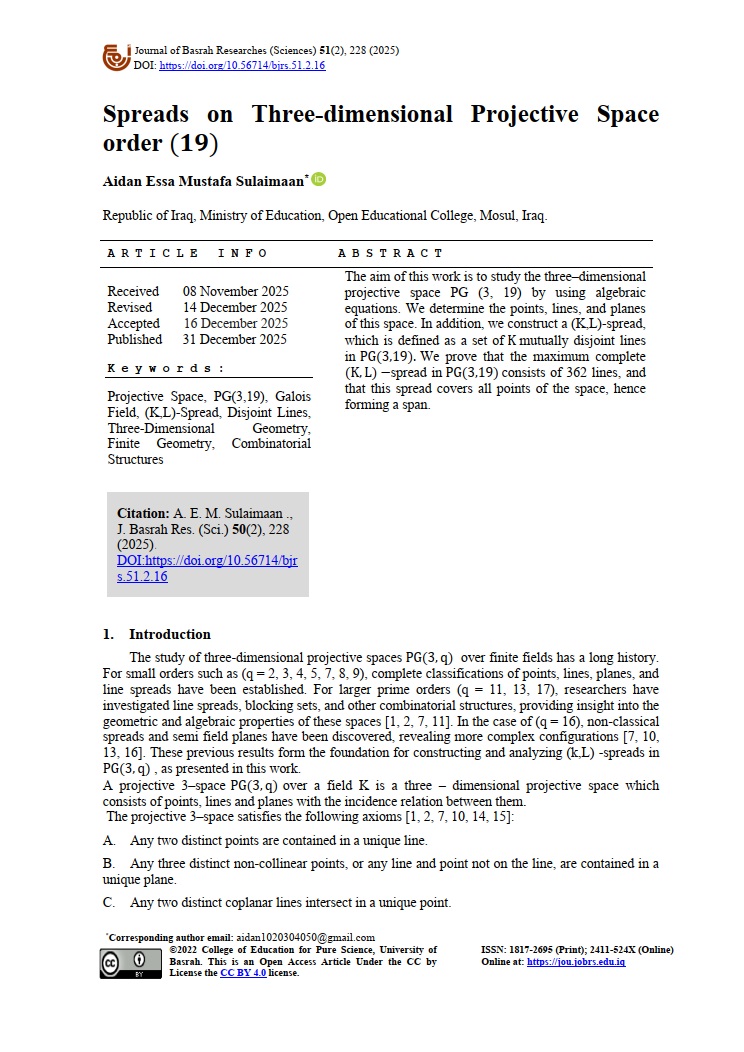
Spreads on Three-dimensional Projective Space order (19)
DOI:
https://doi.org/10.56714/bjrs.51.2.16Keywords:
Projective Space, PG(3,19), Galois Field, (K,L)-Spread, Disjoint Lines, Three-Dimensional Geometry, Finite Geometry, Combinatorial StructuresAbstract
The aim of this work is to study the three–dimensional projective space PG (3, 19) by using algebraic equations. We determine the points, lines, and planes of this space. In addition, we construct a (K,L)-spread, which is defined as a set of K mutually disjoint lines in PG(3,19). We prove that the maximum complete (K,L)-spread in PG(3,19) consists of 362 lines, and that this spread covers all points of the space, hence forming a span.
Downloads
References
[1] A. A. A. Abdulla and N. Y. K. Yahya, “Application of algebraic geometry in three-dimensional projective space PG(3,7),” J. Phys.: Conf. Ser., vol. 1664, no. 1, Art. no. 012090, 2020, doi: 10.1088/1742-6596/1664/1/012090. DOI: https://doi.org/10.1088/1742-6596/1591/1/012077
[2] R. A. S. Al-Jofy, Complete Arcs in a Projective Plane over Galois Field, M.Sc. thesis, College of Education Ibn Al-Haitham, Univ. of Baghdad, Baghdad, Iraq, 1999.
[3] A. S. H. Al-Mukhtar, Complete Arcs and Surfaces in Three-Dimensional Projective Space over Galois Field, M.Sc. thesis, Univ. of Technology, Baghdad, Iraq, 2008.
[4] F. Ayres Jr., Projective Geometry. New York, NY, USA: Schaum Publishing Co., 1967.
[5] D. Bartoli, A. A. Davydov, A. A. Kreshchuk, S. Marcugini, and F. Pambianco, “Tables, bounds and graphics of the smallest known sizes of complete caps in the spaces PG(3,q) and PG(4,q),” arXiv:1610.09656, 2016, doi: 10.48550/arXiv.1610.09656. DOI: https://doi.org/10.1016/j.endm.2017.02.005
[6] A. A. Davydov and A. P. Markov, “Complete caps in projective spaces PG(n,q),” J. Geom., vol. 79, pp. 1–10, 2004, doi: 10.1007/s00022-004-1778-3. DOI: https://doi.org/10.1007/s00022-004-1778-3
[7] A. S. Hassan, Construction of (k,3)-Arcs on Projective Plane over Galois Field GF(q), q = p^h, p = 2, h = 2,3,4, M.Sc. thesis, College of Education Ibn Al-Haitham, Univ. of Baghdad, Baghdad, Iraq, 2001.
[8] J. W. P. Hirschfeld, Projective Geometries over Finite Fields. Oxford, U.K.: Clarendon Press; New York, NY, USA: Oxford Univ. Press, 1979.
[9] J. W. P. Hirschfeld, Projective Geometries over Finite Fields, 2nd ed. Oxford, U.K.: Oxford Univ. Press, 1998. DOI: https://doi.org/10.1093/oso/9780198502951.001.0001
[10] J. W. P. Hirschfeld, “Arcs, caps and generalizations in a finite projective space,” Mathematics, vol. 13, no. 9, Art. no. 1489, 2025, doi: 10.3390/math13091489. DOI: https://doi.org/10.3390/math13091489
[11] F. F. Kareem and S. J. Kadum, “A (k,ℓ)-span in three-dimensional projective space PG(3,p) over Galois field p = 4,” Tech. Rep., College of Education Ibn Al-Haitham, Univ. of Baghdad, Baghdad, Iraq, 2013.
[12] F. C. Langbein, Beautification of Reverse Engineered Geometric Models, Ph.D. dissertation, Cardiff Univ., Cardiff, U.K., 2003.
[13] H. K. Hassan, Reverse Construction of (k,n)-Arcs in PG(2,q) over Some Galois Fields, M.Sc. thesis, College of Education Ibn Al-Haitham, Univ. of Baghdad, Baghdad, Iraq, 2002.
[14] N. A. Ismael, Complete (k,r)-Arcs in the Projective Plane PG(2,13), M.Sc. thesis, College of Education Ibn Al-Haitham, Univ. of Baghdad, Baghdad, Iraq, 2005.
[15] N. Y. Kasm and M. G. Faraj, “Reverse building of complete (k,r)-arcs in PG(2,q),” Open Access Library J., vol. 6, no. 4, 2019, doi: 10.4236/oalib.1105305.
[16] S. F. Mahmood, “Reverse construction of complete (k,n)-arcs in PG(2,13),” College Publication, Al-Iraqia Univ., Baghdad, Iraq, vol. 1, no. 1, May 2013.
Downloads
Published
Issue
Section
License
Copyright (c) 2025 Basrah Researches Sciences

This work is licensed under a Creative Commons Attribution 4.0 International License.
This journal is licensed under the Creative Commons Attribution 4.0 International License (CC BY 4.0).
Under this license, users are permitted to read, download, copy, distribute, print, search, link to the full texts of articles, and create derivative works, including for commercial purposes, provided that appropriate credit is given to the original author(s) and the source.
The copyright of all published articles is transferred to the College of Education for Pure Sciences, University of Basrah. Proper attribution must include the article title, author name(s), journal name, DOI, and a link to the Creative Commons license.