Effect of SLC6A4 polymorphisms on serotonin in individuals with amphetamine use disorder in Basrah, Iraq
DOI:
https://doi.org/10.56714/bjrs.52.1.20Keywords:
SLC6A4, Serotonin, Af VBAf VBAbstract
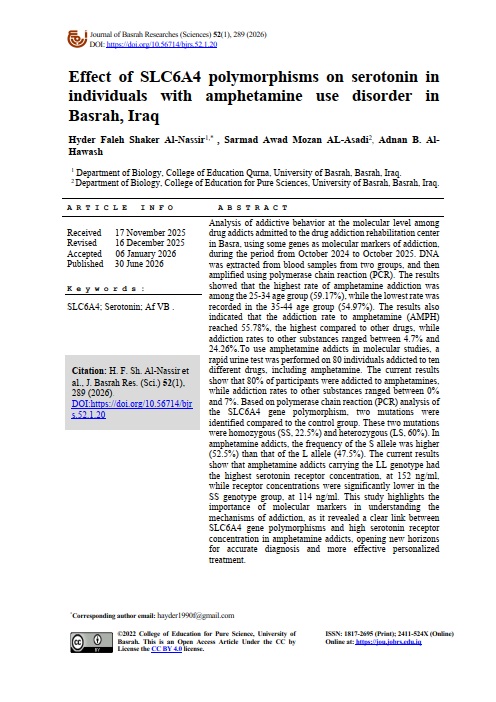
Analysis of addictive behavior at the molecular level among drug addicts admitted to the drug addiction rehabilitation center in Basra, using some genes as molecular markers of addiction, during the period from October 2024 to October 2025. DNA was extracted from blood samples from two groups, and then amplified using polymerase chain reaction (PCR). The results showed that the highest rate of amphetamine addiction was among the 25-34 age group (59.17%), while the lowest rate was recorded in the 35-44 age group (54.97%). The results also indicated that the addiction rate to amphetamine (AMPH) reached 55.78%, the highest compared to other drugs, while addiction rates to other substances ranged between 4.7% and 24.26%. To use amphetamine addicts in molecular studies, a rapid urine test was performed on 80 individuals addicted to ten different drugs, including amphetamine. The current results show that 80% of participants were addicted to amphetamines, while addiction rates to other substances ranged between 0% and 7%. Based on polymerase chain reaction (PCR) analysis of the SLC6A4 gene polymorphism, two mutations were identified compared to the control group. These two mutations were homozygous (SS, 22.5%) and heterozygous (LS, 60%). In amphetamine addicts, the frequency of the S allele was higher (52.5%) than that of the L allele (47.5%). The current results show that amphetamine addicts carrying the LL genotype had the highest serotonin receptor concentration, at 152 ng/ml, while receptor concentrations were significantly lower in the SS genotype group, at 114 ng/ml. This study highlights the importance of molecular markers in understanding the mechanisms of addiction, as it revealed a clear link between SLC6A4 gene polymorphisms and high serotonin receptor concentration in amphetamine addicts, opening new horizons for accurate diagnosis and more effective personalized treatment.
Downloads
References
[1] S. Devi, and S. Singh, “Risk Factors for Drug Addiction: A Review,” Indian Journal of Health & Wellbeing, vol. 14, no. 3, 2023.Available: https://iahrw.org/our-services/journals/indian-journal-of-health-wellbeing/
[2] I. Jabeen, M. Venkataswamy, J. Sadaf, M. N. Reddy, A. Mallika, and M. Sushmitha, “Drug abuse, addiction, its causes and treatment,” Research Journal of Pharmaceutical Dosage Forms and Technology, vol. 10, no. 4, pp. 259-265, 2018. DOI: 10.5958/0975-4377.2018.00038.1 DOI: https://doi.org/10.5958/0975-4377.2018.00038.1
[3] E. Akerele, Substance and non-substance related addictions: a global approach: Springer Nature, 2022.DOI: https://doi.org/10.1007/978-3-030-84834-7 DOI: https://doi.org/10.1007/978-3-030-84834-7
[4] C. P. Müller, and J. R. Homberg, “The role of serotonin in drug use and addiction,” Behavioural brain research, vol. 277, pp. 146-192, 2015. DOI: https://doi.org/10.1016/j.bbr.2014.04.007 DOI: https://doi.org/10.1016/j.bbr.2014.04.007
[5] A. Anderluh, E. Klotzsch, A. W. Reismann, M. Brameshuber, O. Kudlacek, A. H. Newman, H. H. Sitte, and G. J. Schütz, “Single molecule analysis reveals coexistence of stable serotonin transporter monomers and oligomers in the live cell plasma membrane,” Journal of Biological Chemistry, vol. 289, no. 7, pp. 4387-4394, 2014. DOI: https://doi.org/10.1074/jbc.M113.531632 DOI: https://doi.org/10.1074/jbc.M113.531632
[6] I. R. Möller, M. Slivacka, A. K. Nielsen, S. G. Rasmussen, U. Gether, C. J. Loland, and K. D. Rand, “Conformational dynamics of the human serotonin transporter during substrate and drug binding,” Nature communications, vol. 10, no. 1, pp. 1687, 2019. Available: http://creativecommons.org/licenses/by/4.0/. DOI: https://doi.org/10.1038/s41467-019-09675-z
[7] J. F. Støier, T. N. Jørgensen, T. Sparsø, H. B. Rasmussen, V. Kumar, A. H. Newman, R. D. Blakely, T. Werge, U. Gether, and F. Herborg, “Disruptive mutations in the serotonin transporter associate serotonin dysfunction with treatment-resistant affective disorder,” medRxiv, pp. 2023.08. 29.23294386, 2023. DOI: https://doi.org/10.1101/2023.08.29.23294386 DOI: https://doi.org/10.1101/2023.08.29.23294386
[8] S. Hanna, M. Faiz, S. Ahmed, C. Hsieh, S. Temkit, C. Nunez, and F. Zhou, “The interplay between SLC6A4 and HTR1A genetic variants that may lead to antidepressant failure,” The Pharmacogenomics Journal, vol. 25, no. 3, pp. 13, 2025. DOI: https://doi.org/10.1038/s41397-025-00370-5 DOI: https://doi.org/10.1038/s41397-025-00370-5
[9] A. Sudershan, H. Kumar, S. Bailam, R. K. Panjaliya, and P. Kumar, “Impact of 5-HTTLPR of SLC6A4 on migraine susceptibility: A meta-analysis with trial sequential analysis,” Human Gene, vol. 42, pp. 201347, 2024. DOI: https://doi.org/10.1016/j.humgen.2024.201347 DOI: https://doi.org/10.1016/j.humgen.2024.201347
[10] T. Ikegame, Y. Hidaka, Y. Nakachi, Y. Murata, R. Watanabe, H. Sugawara, T. Asai, E. Kiyota, T. Saito, and M. Ikeda, “Identification and functional characterization of the extremely long allele of the serotonin transporter-linked polymorphic region,” Translational psychiatry, vol. 11, no. 1, pp. 119, 2021. DOI: https://doi.org/10.1038/s41398-021-01242-9 DOI: https://doi.org/10.1038/s41398-021-01242-9
[11] M. Shukla, and B. Vincent, “The multi-faceted impact of methamphetamine on Alzheimer’s disease: From a triggering role to a possible therapeutic use,” Ageing research reviews, vol. 60, pp. 101062, 2020. DOI: https://doi.org/10.1016/j.arr.2020.101062 DOI: https://doi.org/10.1016/j.arr.2020.101062
[12] M. Alqallaf, “Toxicological aspect of fatal methamphetamine,” Chem Pharm Res, vol. 3, no. 1, pp. 1-5, 2021. DOI: https://doi.org/10.33425/2689-1050.1016
[13] A. Kuckertz, L. Zhao, O. Kedo, K. Amunts, and N. PalomeroGallagher, “Serotonin receptors in areas of the emotion regulation network in human and rat brains—A comparative autoradiographic study,” Journal of Comparative Neurology, vol. 533, no. 7, pp. e70068, 2025. DOI: https://doi.org/10.1002/cne.70068 DOI: https://doi.org/10.1002/cne.70068
[14] H. K. Hussain, Y. L. Tejada, and A. Barbaro, “A Comparative Analysis of Genetic and Epigenetic Factors in METH Addiction: A Focus on SLC (SLC6A4) and COMT Genes,” Frontiers in Bioscience-Landmark, vol. 30, no. 7, pp. 43887, 2025. DOI: https://doi.org/10.31083/FBL43887. (https://doi.org/10.31083/FBL43887) DOI: https://doi.org/10.31083/FBL43887
[15] S. Giovannini, G. Onder, H. G. van der Roest, E. Topinkova, J. Gindin, M. C. Cipriani, M. D. Denkinger, R. Bernabei, R. Liperoti, and S. S. Investigators, “Use of antidepressant medications among older adults in European long-term care facilities: a cross-sectional analysis from the SHELTER study,” BMC geriatrics, vol. 20, no. 1, pp. 310, 2020. DOI: https://doi.org/10.1186/s12877-020-01730-5 DOI: https://doi.org/10.1186/s12877-020-01730-5
[16] H. Njuguna, J. Gong, K. Hutchinson, M. Ndiaye, J. Sabel, and C. Wasserman, “Increasing rates of methamphetamine/amphetamine-involved overdose hospitalizations in Washington State, 2010–2017,” Addictive Behaviors Reports, vol. 14, pp. 100353, 2021. DOI: https://doi.org/10.1016/j.abrep.2021.100353 DOI: https://doi.org/10.1016/j.abrep.2021.100353
[17] Y. Liu, N. Liu, W. Shen, L. Li, W. Zhou, and L. Xu, “The abuse characteristics of amphetamine-type stimulants in patients receiving methadone maintenance treatment and buprenorphine maintenance treatment,” Drug design, development and therapy, pp. 2109-2116, 2021. DOI: https://doi.org/10.2147/DDDT.S305226 DOI: https://doi.org/10.2147/DDDT.S305226
[18] S. D. AlOtaibi, H. A. Elsisi, M. J. AlShammary, S. A. AlQader, H. A. AlHarbi, B. R. AlOlaiyan, A. O. Alanazi, F. S. AlMendeel, Y. N. AlHarbi, and I. AlKhalaf, “Evaluation of the Psychiatric Disorders among Amphetamine Addicts in Rehabilitation Centers: A Cross‐Sectional Analysis,” Journal of Toxicology, vol. 2024, no. 1, pp. 1643693, 2024. DOI: https://doi.org/10.1155/2024/1643693 DOI: https://doi.org/10.1155/2024/1643693
[19] Z. S. Quader, “Routes of Marijuana Use—Behavioral Risk Factor Surveillance System, 22 US States and Two Territories, 2022,” MMWR. Morbidity and Mortality Weekly Report, vol. 74, 2025. DOI: http://dx.doi.org/10.15585/mmwr.mm7412a1 DOI: https://doi.org/10.15585/mmwr.mm7412a1
[20] E. A. Herrnsdorf, A. Holmstedt, and A. Håkansson, “Tramadol misuse in treatment-seeking adolescents and young adults with problematic substance use–Prediction of treatment retention,” Addictive Behaviors Reports, vol. 16, pp. 100446, 2022. DOI: https://doi.org/10.1016/j.abrep.2022.100446 DOI: https://doi.org/10.1016/j.abrep.2022.100446
[21] M. R. Spencer, M. Garnett, and A. M. Miniño, "Drug overdose deaths in the United States, 2002-2022," US Department of Health and Human Services, Centers for Disease Control and …, 2024. DOI: https://dx.doi.org/10.15620/cdc:135849 DOI: https://doi.org/10.15620/cdc:135849
[22] S. U. K. Jan, H. Alam, and A. Khan, “An Analysis of Risk Factors Associated with Methamphetamine/ICE use in Khyber,” Global Sociological Review, vol. 6, pp. 111-118, 2021. DOI: https://doi.org/10.31703/gsr.2021(VI-I).15 DOI: https://doi.org/10.31703/gsr.2021(VI-I).15
[23] A. B. Ruzilawati, M. S. Deeza-Syafiqah, I. Ahmad, S. Shamsuddin, S. H. Gan, and B. K. Vicknasingam, “Influence of dopaminergic system gene polymorphisms on mixed amphetamine-type stimulants and opioid dependence in Malaysian Malays,” Egyptian Journal of Medical Human Genetics, vol. 20, no. 1, pp. 7, 2019. DOI: https://doi.org/10.1186/s43042-019-0005-6 DOI: https://doi.org/10.1186/s43042-019-0005-6
[24] R. Miozzo, W. W. Eaton, O. J. Bienvenu III, J. Samuels, and G. Nestadt, “The serotonin transporter gene polymorphism (SLC6A4) and risk for psychiatric morbidity and comorbidity in the Baltimore ECA follow-up study,” Comprehensive psychiatry, vol. 102, pp. 152199, 2020. DOI: https://doi.org/10.1016/j.comppsych.2020.152199 DOI: https://doi.org/10.1016/j.comppsych.2020.152199
[25] А. Крылов, Н. Павлова, and А. Бочуров, “Роль вариации 5-HTTLPR гена SLC6A4 cеротонинергической системы в формировании аддиктивных расстройств: нарративный обзор литературы,” 2025. DOI: 10.17816/CP15611 DOI: https://doi.org/10.17816/CP15611
Downloads
Published
Issue
Section
License
Copyright (c) 2026 Journal of Basrah Researches (Sciences)

This work is licensed under a Creative Commons Attribution 4.0 International License.
This journal is licensed under the Creative Commons Attribution 4.0 International License (CC BY 4.0).
Under this license, users are permitted to read, download, copy, distribute, print, search, link to the full texts of articles, and create derivative works, including for commercial purposes, provided that appropriate credit is given to the original author(s) and the source.
The copyright of all published articles is transferred to the College of Education for Pure Sciences, University of Basrah. Proper attribution must include the article title, author name(s), journal name, DOI, and a link to the Creative Commons license.