Effect of Aqueous and Alcoholic Seeds Extracts of Peganum harmala on Hematological, Biochemical and Growth performance parameters in Broiler Chicken
DOI:
https://doi.org/10.56714/bjrs.52.1.21Keywords:
Broiler Chicken, Peganum Harmala, Seed Extract, Hematology, Biochemical ParametersAbstract
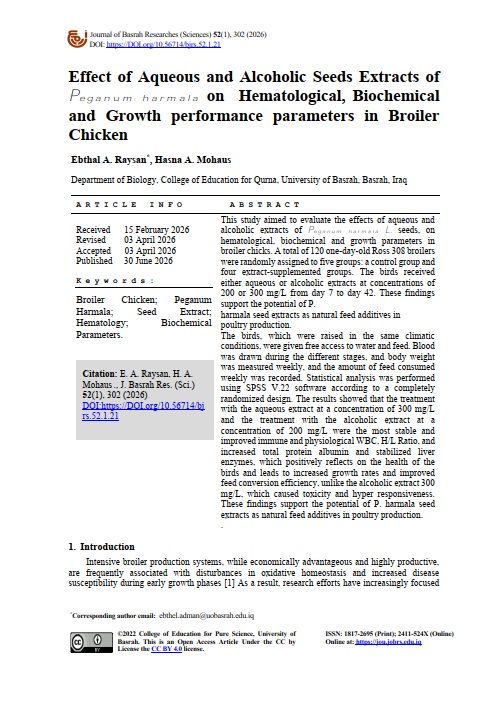
This study aimed to evaluate the effects of aqueous and alcoholic extracts of Peganum harmala L. seeds, on hematological, biochemical and growth parameters in broiler chicks. A total of 120 one-day-old Ross 308 broilers were randomly assigned to five groups: a control group and four extract-supplemented groups. The birds received either aqueous or alcoholic extracts at concentrations of 200 or 300 mg/L from day 7 to day 42. These findings support the potential of P. harmala seed extracts as natural feed additives in poultry production.
The birds, which were raised in the same climatic conditions, were given free access to water and feed. Blood was drawn during the different stages, and body weight was measured weekly, and the amount of feed consumed weekly was recorded. Statistical analysis was performed using SPSS V.22 software according to a completely randomized design. The results showed that the treatment with the aqueous extract at a concentration of 300 mg/L and the treatment with the alcoholic extract at a concentration of 200 mg/L were the most stable and improved immune and physiological WBC, H/L Ratio, and increased total protein albumin and stabilized liver enzymes, which positively reflects on the health of the birds and leads to increased growth rates and improved feed conversion efficiency, unlike the alcoholic extract 300 mg/L, which caused toxicity and hyper responsiveness. These findings support the potential of P. harmala seed extracts as natural feed additives in poultry production.
Downloads
References
[1] T. M. Sultan Arshad, M. Al-Mothefer, and A. K. Jassim, "Influence of adding fresh Azolla on the productive and physiological traits of Iraqi local ducks", Journal of Infection and Public Health, vol. 1549, no. 1, Art. no. 012091, 2025, DOI:10.1016/j.jiph.2024.102592. DOI: https://doi.org/10.1088/1755-1315/1549/1/012091
[2] B. Song, D. Tang, S. Yan, H. Fan, G. Li, M. S. Shahid, T. Mahmood, and Y. Guo,
" Effects of age on immune function in broiler chickens", Journal of Animal Science and Biotechnology, vol. 12, Art. no. 42, 2021. DOI https://doi.org/10.1186/s40104-021-00559-1. DOI: https://doi.org/10.1186/s40104-021-00559-1
[3] M. Alagawany, M. E. Abd El-Hack, M. R. Farag, M. Gopi, K. Karthik, Y. S. Malik, and K. Dhama, "Phytogenic feed additives as alternatives to antibiotic growth promoters in poultry", Animals, vol. 11, no. 6, Art. no. 1696, 2021, DOI: 10.3390/ani11061696 . DOI: https://doi.org/10.3390/ani11061696
[4] R. Ahmad Dar, M. Shahnawaz, M. A. Ahanger, and I. ul Majid, "Exploring the diverse bioactive compounds from medicinal plants: A review", Phytomedicine Plus, vol. 3, no. 4, Art. no. 100507, 2023, DOI:10.1016/j.phyplu.2023.100507 DOI: https://doi.org/10.1016/j.phyplu.2023.100507
[5] N. Arshad, C. Neubauer, S. Hasnain, and M. Hess, "Peganum harmala can.
minimize Escherichia coli infection in poultry, but long-term feeding may induce side effects",Poultry Science, vol. 87, no. 2, pp. 240–249, 2008, DOI:10.3382/ps.2007-00341. DOI: https://doi.org/10.3382/ps.2007-00341
[6] N. M. El-Abd, R. A. Hamouds, A. A. Saddiq, T. M. Al-Shaikh, T. J. Khusaifan, and
G. Abou-El-Souod, "Effect of dietary Arthrospira platensis phycocyanin on broiler chicken growth performance, physiological status, fatty and amino acid profiles", Veterinary World, vol. 17,
no. 5, pp. 1098–1107, 2024
[7] S. A. Amer, M. E. Abd El-Hack, M. Alagawany, and A. E. Taha, "Blood biochemical and hematological responses as indicators of poultry health", Frontiers in Veterinary Science, vol. 9, Art. no. 912, 2022
[8] C. Abou-Jaoudeh, J. Andary, and R. Abou-Khalil, "Antibiotic residues in poultry products and bacterial resistance: A review in developing countries", Journal of Infection and Public Health, vol. 17, no.12, Art. no. 102592, 2024 DOI: https://doi.org/10.1016/j.jiph.2024.102592
[9] S. Zheng, Y. Li, C. Chen, N. Wang, and F. Yang, "Solutions to the dilemma of
antibiotics use in livestock and poultry farming: Regulation policy and alternatives", Toxics, vol. 13, no. 5, Art. no. 348, 2025, DOI:10.3390/toxics13050348 DOI: https://doi.org/10.3390/toxics13050348
[10] J. J. Dibner, and J. D. Richards, "Antibiotic growth promoters in agriculture: History and mode of action", Poultry Science, vol. 100, no. 7, Art. no. 101210, 2021
[11] G. Huyghebaert, R. Ducatelle, and F. Van Immerseel, "Replacement of antibiotic growth promoters in poultry", World's Poultry Science Journal, vol. 78, no. 1, pp. 1–16, 2022
[12] S. Ivanova, S. Sukhikh, A. Popov, O. Shishko, I. Nikonov, E. Kapitonova, and O. Babich, "Medicinal plants: A source of phytobiotics for the feed additives", Journal of Agriculture and Food Research, vol. 16, Art. no. 101164, 2024 DOI: https://doi.org/10.1016/j.jafr.2024.101172
[13] M. Moloudizargari, P. Mikaili, S. Aghajanshakeri, M. H. Asghari, and J. Shayegh, "Pharmacological and therapeutic effects of Peganum harmala and its main alkaloids", Pharmacognosy Reviews, vol. 7, no. 14, pp. 199–212, 2013 DOI: https://doi.org/10.4103/0973-7847.120524
[14] M. Moradi, A. Karimi, H. Alimi, N. DoRafieian-Kopaei, and F. FotouhiIn, "In vitro antiviral effects of Peganum harmala seed extract and its total alkaloids against Influenza virus", Microbial Pathogenesis, vol. 110, pp. 42–49, 2017 DOI: https://doi.org/10.1016/j.micpath.2017.06.014
[15] A. E. Al-Snafi, "Medicinal plants as safe alternatives in animal production", Iraqi Journal of Veterinary Sciences, vol. 37, no. 2, pp.1–10, 2023
[16] J.-E. Lee, J. T. M. Jayakody, J.-I. Kim, J.-W. Jeong, K.-M. Choi, T.-S. Kim, and B. Ryu, "The influence of solvent choice on the extraction of bioactive compounds from Asteraceae: A comparative review", Foods, vol. 13, no. 19, Art. no. 3151, 2024 DOI: https://doi.org/10.3390/foods13193151
[17] L.-N. Li, "Peganum harmala L.: A review of botany, traditional use, phytochemistry, pharmacology, quality marker, and toxicity", Combinatorial Chemistry & High Throughput Screening, vol. 27, no. 6, pp. 797–822, 2024 DOI: https://doi.org/10.2174/1386207326666230622164243
[18] A. Adetumbi Tella, "Effect of strain on haematology and serum biochemical profile of broiler chickens fed aqueous extract of bitter leaf", Journal of Applied Animal Research, vol. 53, no. 1, pp. 1–17, 2025
[19] M. Khalid, F. Al-Rimawi, S. Darwish, Z. Salah, G. M. Al-Mazaideh, "Assessment of the anticancer, antimicrobial, and antioxidant activities of the Peganum harmala L. plant", Natural Product Communications, vol. 19, no. 6, pp. 1–10, 2024 DOI: https://doi.org/10.1177/1934578X241260597
[20] P. Cao-Ngoc, L. Leclercq, J.-C. Rossi, J. Hertzog, A.-S. Tixier, F. Chemat, and H. Cottet, "Water-based extraction of bioactive principles from blackcurrant leaves and Chrysanthellum americanum: A comparative study," Molecules, vol. 25, no. 14, Art. no. 3286, 2020 DOI: https://doi.org/10.3390/foods9101478
[21] C. M. Huang, and T. T. Lee "Immunomodulatory effects of phytogenics in chickens and pigs—A review", Asian-Australasian Journal of Animal Sciences, vol. 31, no. 5, pp. 617–627, 2018 DOI: https://doi.org/10.5713/ajas.17.0657
[22] M. H. Simonian, "Spectrophotometric Determination of Protein Concentration", Current Protocols in Food Analytical Chemistry, 2002, DOI:10.1002/0471142913.fab0103s04 DOI: https://doi.org/10.1002/0471142913.fab0103s04
[23] P. R. Okorodudu, A. A. Pelletier, G. N. Valcour, Jr. Bowers, and R. B. McComb, "Evaluation of the IFCC reference method for alanine aminotransferase: spurious blank ALT activity due to contamination of D-alanine with L-alanine, and recommendations for a correction", Clinical Chemistry, vol. 35, no. 1, pp. 153–156, 1989, DOI:10.1093/clinchem/35.1.153 DOI: https://doi.org/10.1093/clinchem/35.1.153
[24] S. R. Banoon, A. H. Sarhan, F. J. Ibrahim, Z. A. Hussein, and A. Ghasemian, "Drugs loaded in bilosomes for the treatment of gastrointestinal cancers: A comprehensive review", Advances in Biology & Earth Sciences, vol. 10, no. 1, pp.111–134, 2025 DOI: https://doi.org/10.62476/abes.101111
[25] H. J. Al-Daraji, W. K. Al-Hayani, and A. S. Al-Hassani, Bird Blood Vessel, Baghdad,. Iraq: University of Baghdad, College of Agriculture, 2008
[26] C. Akomah, O. M. Sogunle, O. A. Adeyemi, and A. M. Bamgbose, "Growth performance and haematological characteristics of pullet chickens fed different feed forms
supplemented with or without Oyster mushroom (Pleurotus ostreatus)" Nigerian Journal of Animal Production, vol. 48, no. 5, pp. 203-212, 2021 DOI: https://doi.org/10.51791/njap.v48i5.3202
[27] V. pirgozliev, S. C. Mansbridge, S. P. Rose, H. S. Lillehoj, and D. "Bravo, Immune modulation, growth performance, and nutrient retention in broiler chickens fed a blend of phytogenic feed additives", Poultry Science, vol. 98, no. 9, pp. 3443–3449, 2019, DOI:10.3382/ps/pey472 DOI: https://doi.org/10.3382/ps/pey472
[28] Z. Nazari, H. Shirzadi, K. Taherpour, E. Rahmatnejad, and A. Khatibjoo, "Effect of dietary medicinal plants on physiological responses of broiler chickens challenged with Campylobacter jejuni" Veterinary Medicine and Science, vol. 10, no. 5, Art. no. e70028, 2024 DOI: https://doi.org/10.1002/vms3.70028
[29] E. O. S. Hussein, S. Selim, M. E. Abd El-Hack, and A. E. Taha, "Herbal extracts as alternatives to antibiotic growth promoters in poultry nutrition: A review",
Animals, vol. 12, no.4, Art. no. 453, 2022, DOI:10.3390/ani12040453 DOI: https://doi.org/10.3390/ani12040453
[30] S. Rahimi, M. Teymouri, M. A. Karimi Torshizi, R. Omidbaigi, and H. Rokni, "Effect of plant extracts on performance, immune response and intestinal microflora of broiler chicken" Journal of Animal Physiology and Animal Nutrition, vol. 104, no. 2, pp. 675–684, 2020
[31] O. Orakpoghenor, D. O. Avazi, T. P. Markus, and O. S. Olaolu, "Lymphocytes: a
brief review," Scientific Research and Literature, vol. 3, no. 1, pp. 005-009, 2019
[32] C. J. C. Phillips, B. Hosseintabar-Ghasemabad, I. F. Gorlov, M. I. Slozhenkina, A. A. Mosolov, and A. Seidavi, "Immunomodulatory effects of natural feed additives for meat chickens", Life, vol. 13, no. 6, Art. no. 1287, 2023 DOI: https://doi.org/10.3390/life13061287
[33] P. F. Surai, "Selenium in poultry nutrition and health", World's Poultry Science
Journal, vol. 76, no. 4, pp. 615-636, 2020, DOI:10.1080/00439339.2020.1830012 DOI: https://doi.org/10.1080/00439339.2020.1830012
[34] B. J. Gurley, M. R. McGill, and I. Koturbash, "Hepatotoxicity due to herbal dietary supplements: Past present and the future", Food and Chemical Toxicology, vol. 169, Art. No. 113445, 2022, DOI:10.1016/j.fct.2022.113445 DOI: https://doi.org/10.1016/j.fct.2022.113445
[35] G. Attia, W. El-Eraky, E. Hassanein, M. El-Gamal, M. Farahat, and A. Hernandez-Santan, "Effect of dietary inclusion of a plant extract blend on broiler growth performance, nutrient digestibility, caecal microflora and intestinal histomorphology" International Journal of Poultry Science, vol. 16, no. 7, pp. 344–353, 2022, DOI:10.3923/ijps.2017.344.353 DOI: https://doi.org/10.3923/ijps.2017.344.353
Downloads
Published
Issue
Section
License
Copyright (c) 2026 Journal of Basrah Researches (Sciences)

This work is licensed under a Creative Commons Attribution 4.0 International License.
This journal is licensed under the Creative Commons Attribution 4.0 International License (CC BY 4.0).
Under this license, users are permitted to read, download, copy, distribute, print, search, link to the full texts of articles, and create derivative works, including for commercial purposes, provided that appropriate credit is given to the original author(s) and the source.
The copyright of all published articles is transferred to the College of Education for Pure Sciences, University of Basrah. Proper attribution must include the article title, author name(s), journal name, DOI, and a link to the Creative Commons license.